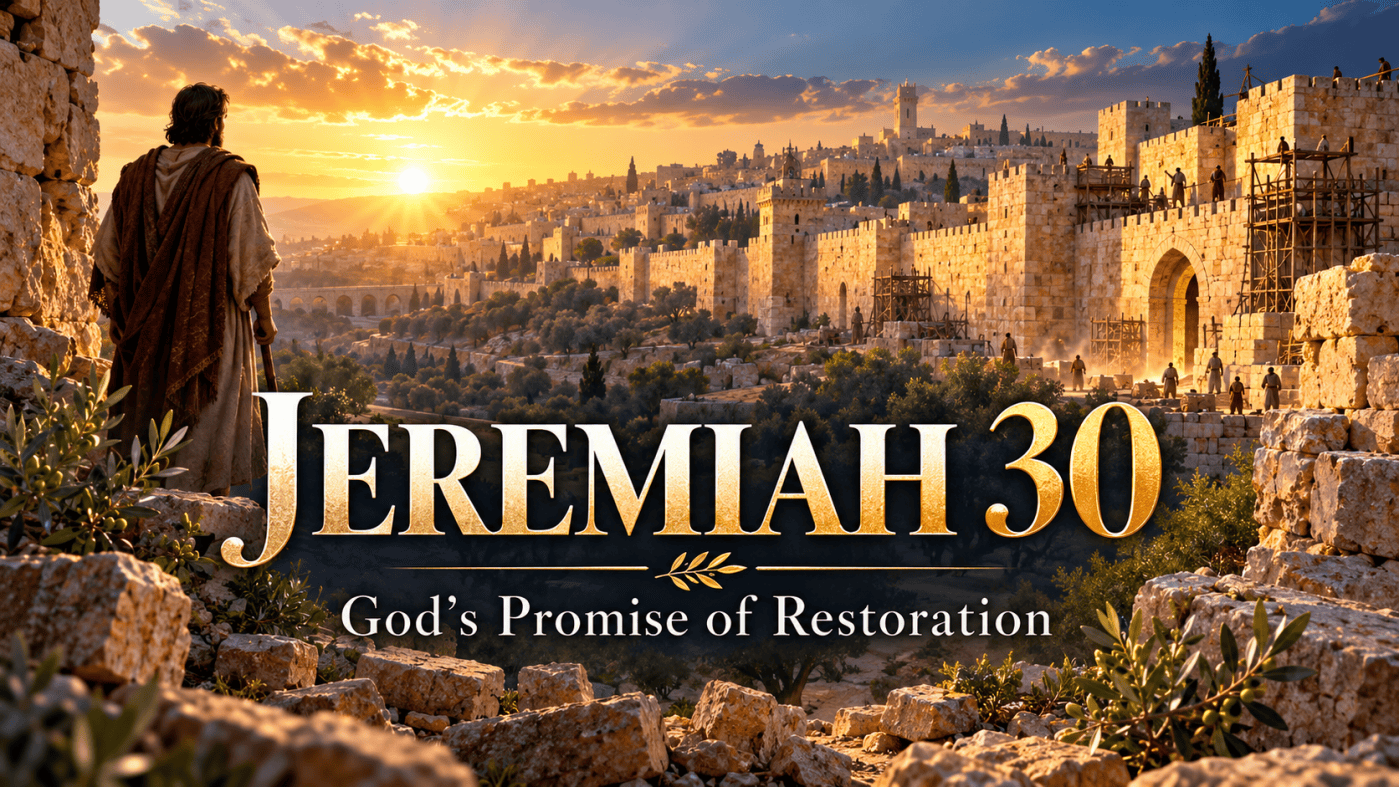
Jeremiah 30 opens a sustained message of consolation amid warnings of judgment. God speaks to Israel and Judah about anguish, exile, healing, and homecoming. His promise reaches its center in restored relationship: “You shall be my people, and I will be your God.”
This commentary follows the chapter passage by passage, distinguishing its promises to Israel and Judah from Christian applications to our lives. Scripture quotations use the public-domain World English Bible (updated edition).
Jeremiah 30:1–3 — A Written Promise of Restoration
The word that came to Jeremiah from the LORD, saying, “The LORD, the God of Israel, says, ‘Write all the words that I have spoken to you in a book. For, behold, the days come,’ says the LORD, ‘that I will reverse the captivity of my people Israel and Judah,’ says the LORD. ‘I will cause them to return to the land that I gave to their fathers, and they will possess it.’”
God tells Jeremiah to preserve His promise in writing. His people need something enduring to hold onto while their circumstances tell a painful story. Judgment is real, but exile will not erase God’s purposes. The promise specifically concerns Israel and Judah and their return to the land given to their ancestors.
The Hebrew expression often summarized as shuv shevut carries the sense of restoring fortunes. In this verse, the following promise of return to the land makes restoration from exile explicit. God’s work reaches people whose national life has been shattered.
God’s faithfulness rests on His character. We are dependent, changeable creatures; He is the Creator who depends on nothing outside Himself. His holiness means He takes disobedience seriously, and His mercy means failure does not exhaust His capacity to restore. Christian readers can connect this assurance with Hebrews 13:5 and Romans 8:38–39, while preserving Jeremiah’s original promise to Israel and Judah. The explicit promise of an everlasting covenant appears later in Jeremiah 32:40.
Jeremiah 30:4–7 — Hope in the Midst of Anguish
These are the words that the LORD spoke concerning Israel and concerning Judah. For the LORD says: “We have heard a voice of trembling; a voice of fear, and not of peace. Ask now, and see whether a man travails with child. Why do I see every man with his hands on his waist, as a woman in travail, and all faces are turned pale? Alas, for that day is great, so that none is like it! It is even the time of Jacob’s trouble; but he will be saved out of it.”
The childbirth imagery communicates overwhelming distress. Men who might ordinarily represent strength are doubled over in anguish. “Jacob” identifies God’s covenant people collectively. Whatever further prophetic horizons readers understand here, the passage first addresses their suffering and promised deliverance.
God promises restoration without pretending that suffering is insignificant. We live in a world of trials, and we need the Lord to sustain us and restore our souls. Jesus likewise tells His followers to expect tribulation while taking courage in His victory (John 16:33). We trust God through hardship without assuming every difficulty will end on our preferred timetable.
Jeremiah 30:8–9 — Freedom Under a Righteous King
“It will come to pass in that day, says the LORD of Armies, that I will break his yoke from off your neck, and will burst your bonds. Strangers will no more make them their bondservants; but they will serve the LORD their God, and David their king, whom I will raise up to them.”
The yoke represents foreign domination. God breaks the bonds of oppressive masters so His people may serve Him. Deliverance leads into renewed allegiance and fellowship.
David lived centuries before Jeremiah. The promise evokes restored Davidic kingship, which Christians understand as ultimately fulfilled in Jesus, the Messiah descended from David. Jesus also teaches that those who practice sin are enslaved to it and that the Son gives true freedom (John 8:34–36). That is a Christian connection to the passage’s immediate promise of liberation from foreign rule.
Eden helps us understand freedom under God’s authority. Adam and Eve received abundance, choices, and a command they were to honor. God’s boundary was good. Disobedience brought the death He had warned about. Likewise, sin promises independence while drawing us into bondage. Christ frees us to live in fellowship with our Creator, whose wisdom guides us toward life.
Jeremiah 30:10–11 — Correction Without Abandonment
“Therefore don’t be afraid, O Jacob my servant, says the LORD. Don’t be dismayed, Israel. For, behold, I will save you from afar, and save your offspring from the land of their captivity. Jacob will return, and will be quiet and at ease. No one will make him afraid. For I am with you, says the LORD, to save you; for I will make a full end of all the nations where I have scattered you, but I will not make a full end of you; but I will correct you in measure, and will in no way leave you unpunished.”
“I am with you” stands beside “I will correct you.” God’s presence does not make Him indifferent to sin. He commits Himself to preserving His people while dealing seriously with their rebellion.
A traffic signal offers a simple illustration. Running a red light can bring a substantial penalty because a collision can devastate lives. The boundary concerns a real danger. Similarly, God’s commandments address things that matter deeply, and His correction calls us away from destruction. Hebrews 12:5–11 develops the picture of loving, fatherly discipline.
I recently spoke with a missionary brother about the danger of becoming numb to sin. Romans 1:28 describes God giving people over to a debased mind amid persistent rejection of Him. Conviction can therefore be a mercy that awakens us to repentance. A temporary lack of strong feelings, however, does not by itself establish that God has abandoned someone. Jeremiah’s emphasis here is His explicit commitment to preserve and correct His people.
Jeremiah 30:12–15 — When Our Own Solutions Cannot Heal Us
For the LORD says, “Your hurt is incurable. Your wound is grievous. There is no one to plead your cause, that you may be bound up. You have no healing medicines. All your lovers have forgotten you. They don’t seek you. For I have wounded you with the wound of an enemy, with the chastisement of a cruel one, for the greatness of your iniquity, because your sins were increased. Why do you cry over your injury? Your pain is incurable. For the greatness of your iniquity, because your sins have increased, I have done these things to you.”
The wound portrays Judah’s devastation under judgment. Her “lovers” evokes unfaithful dependencies, including foreign alliances. Those she trusted cannot save her. The repeated declaration that her condition is incurable prepares us for the surprising promise of divine healing in verse 17.
We also ask created things to accomplish what only God can do. Money offers security, careers offer significance, and relationships offer belonging. These can be good gifts, yet none can regenerate the heart or grant new birth. They cannot carry the weight of our ultimate hope.
Stars and galaxies, lakes and trees, and the food growing in a garden reflect the Creator’s goodness. They are like mirrors directing our attention toward Him. We lose our way when we turn a gift into a god. Our deepest satisfaction belongs in the living God, the eternal Creator of the universe. We can gratefully receive practical help, relationships, and medicine while recognizing that salvation comes from Him.
Jeremiah 30:16–17 — God Remembers the Outcast
“Therefore all those who devour you will be devoured. All your adversaries, everyone of them, will go into captivity. Those who plunder you will be plunder. I will make all who prey on you become prey. For I will restore health to you, and I will heal you of your wounds,” says the LORD, “because they have called you an outcast, saying, ‘It is Zion, whom no man seeks after.’”
The reversal is extraordinary. God promises to heal the wound human resources cannot cure. Zion’s enemies call her an outcast, but their contempt does not cancel His covenant mercy. Her restoration arises from His compassion rather than any claim that she has earned it. This corporate promise of restoration is not a guarantee that every individual illness will be healed in this life.
God’s concern for the rejected challenges our own priorities. James 1:27 joins care for orphans and widows in their affliction with remaining unstained by the world. These were people especially vulnerable to deprivation and exploitation.
Jesus’ encounter with the Samaritan woman in John 4 also reveals His willingness to cross entrenched ethnic, religious, and social barriers. The disciples marvel that He is speaking with a woman, and the chapter explicitly describes the division between Jews and Samaritans. Every person bears God’s image. Ethnicity, wealth, and reputation give no one a superior claim on grace. His mercy calls us to serve people whom others overlook.
Jeremiah 30:18–20 — Thanksgiving in a Restored Community
The LORD says: “Behold, I will reverse the captivity of Jacob’s tents, and have compassion on his dwelling places. The city will be built on its own hill, and the palace will be inhabited in its own place. Thanksgiving will proceed out of them with the voice of those who make merry. I will multiply them, and they will not be few; I will also glorify them, and they will not be small. Their children also will be as before, and their congregation will be established before me. I will punish all who oppress them.”
Restoration includes dwelling places, community, children, celebration, and protection from oppression. God’s compassion reaches the shared life of His people. Streets once marked by devastation will carry the sound of thanksgiving.
Thanksgiving reminds us that life is precious because it is God’s gift. Every breath offers another opportunity to honor Him. We were created for His glory, yet our attention so easily turns toward ourselves. Gratitude helps us recognize His goodness in what we once took for granted.
The order matters: God restores, and thanksgiving flows from His mercy. Gratitude does not purchase restoration. It expresses renewed fellowship and helps shape our hearts toward worship. Remembering His faithfulness during comfortable seasons keeps us from forgetting how much we depend on Him.
Jeremiah 30:21–22 — Belonging to the King
“Their prince will be one of them, and their ruler will proceed from among them. I will cause him to draw near, and he will approach me; for who is he who has had boldness to approach me?” says the LORD. “You shall be my people, and I will be your God.”
The promised ruler comes from among the people, and God grants him access to His presence. Alongside verse 9’s Davidic promise, Christians read this hope as ultimately finding fulfillment in Jesus, who represents His people and brings them near to God.
“You shall be my people, and I will be your God” brings restoration to its deepest expression: covenant relationship. God claims His people and commits Himself to them. His authority carries both holiness and reassurance.
Even those accustomed to leading and protecting others need someone greater than themselves. As men, we may feel responsible for having answers and carrying burdens. Yet we, too, need guidance and rescue. Dependence on God acknowledges the truth about who we are. His wisdom exceeds our understanding, and His strength exceeds our own. Belonging to Him calls us to obedience while giving us confidence to entrust ourselves to His care.
Jeremiah 30:23–24 — Trusting God While We Wait
“Behold, the LORD’s storm, his wrath, has gone out, a sweeping storm; it will burst on the head of the wicked. The fierce anger of the LORD will not return until he has accomplished, and until he has performed the intentions of his heart. In the latter days you will understand it.”
The chapter closes with judgment after its promises of restoration. The God who heals His people also confronts wickedness. The storm emphasizes the force of His judgment; the final sentence points toward understanding that comes later.
God’s authority to judge gives substance to our confidence in His protection. Christians recognize Jesus as the Lion of the tribe of Judah (Revelation 5:5), and the following vision of the slain Lamb shows the character of His victory. Evil will not have the final word.
Waiting can still be difficult. We experience disappointment and sometimes struggle to believe that things will be okay. We return to Scripture and remember how God has sustained us. Jesus’ teaching about mustard-seed faith directs our dependence toward God, even when our faith feels small (Matthew 17:20). It is no formula for obtaining every outcome we desire.
Trust means relying on God’s wisdom, presence, and ultimate victory through whatever comes. We can bring Him our uncertainty, continue in prayer, and take the next step of obedience. Understanding may come later. His character gives us reason to trust Him now.
A Prayer for Trust and Restoration
Lord, thank You for Your faithfulness. Correct us where we have wandered, turn our hearts away from idols, and teach us to receive Your gifts with gratitude. Help us care for those whom others overlook. Give us courage to trust Your wisdom while we wait, and lead us in obedience to Jesus, our Savior and King. Amen.
Explore the Jeremiah commentary directory · Previous study: Jeremiah 29
Scripture: Jeremiah 30, World English Bible (public domain). Hebrew restoration expression: see the NET Bible translation notes on Jeremiah 30:3. Featured image is an artistic illustration of restoration, not an archaeological reconstruction.


Leave a Reply