Have you ever made choices you regretted and wondered whether you could ask God to forgive you one more time?
I have. There have been moments when I knew better, chose poorly, and found myself returning to the Lord in prayer. I am grateful for His patience. But I never want to treat His forgiveness casually. I want His mercy to produce obedience in my life.
Jonah 2 brings us into the prayer of a man who had been running from God. His circumstances were desperate, yet God had not stopped dealing with him.
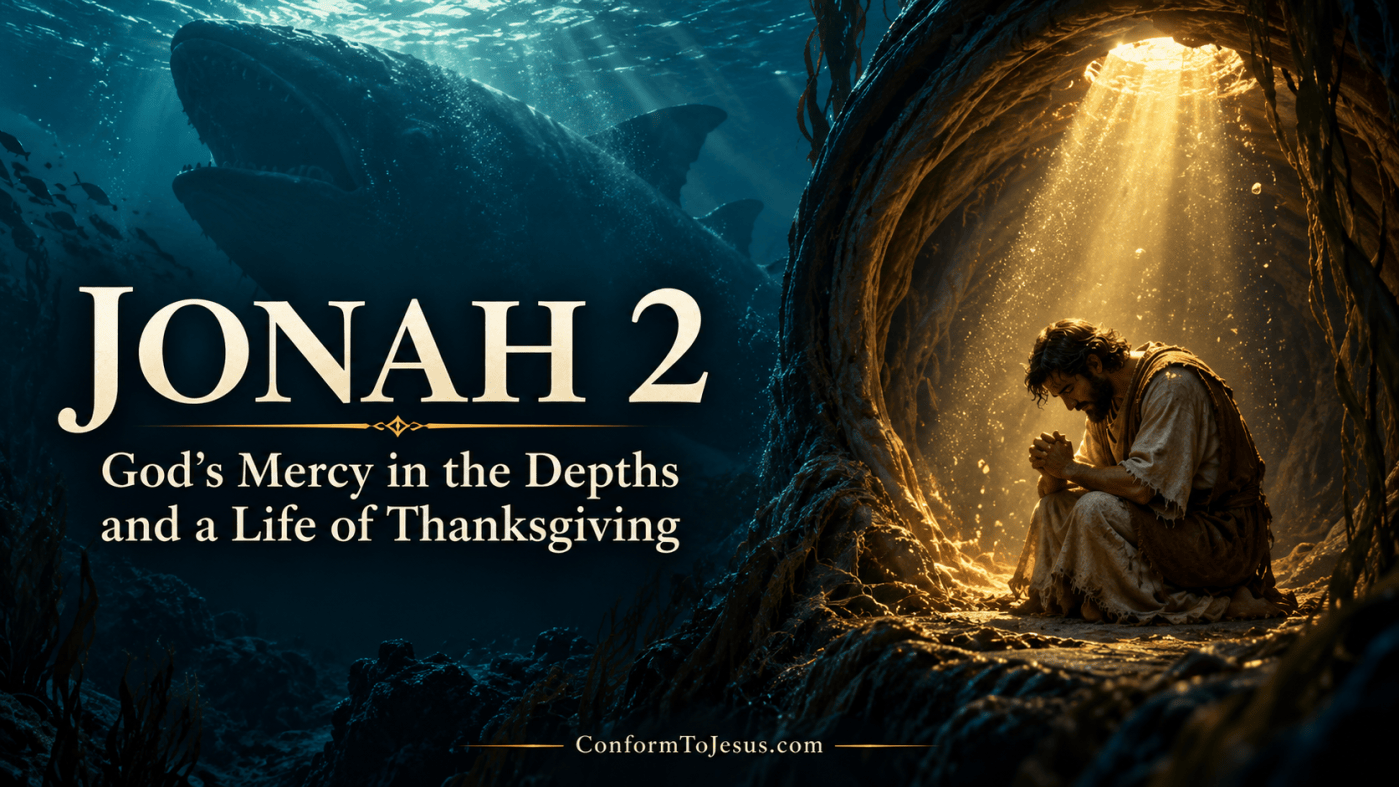
Inside the great fish, Jonah prayed.
This chapter invites us to consider our own dependence on God. Where do we turn when our strength fails? What happens when achievement cannot give us security? How should we respond when God rescues us?
As we work through Jonah’s prayer, a few Hebrew expressions will help us appreciate its depth. But the central truth is wonderfully accessible: we can call upon the Lord from the depths, and deliverance belongs to Him.
Scripture quotations are from the World English Bible.
Jonah 2:1–2 — Calling Upon God After Running Away
1 Then Jonah prayed to the LORD, his God, out of the fish’s belly.
2 He said,
“I called because of my affliction to the LORD.
He answered me.
Out of the belly of Sheol I cried.
You heard my voice.”
Jonah’s disobedience did not prevent him from praying. The man who had fled from the Lord now called upon Him.
The preceding chapter describes the creature as a דָּג גָּדוֹל (dag gadol), a “great fish.” Dag means “fish,” and gadol means “great” or “large.” The Hebrew does not identify its species. Whatever questions we have about the creature, the narrative emphasizes that God appointed it.
The fish was also the means by which Jonah survived. Within this frightening experience, God was preserving his life.
Jonah describes his cry as coming from the “belly of Sheol.” שְׁאוֹל (Sheʾol) refers to the realm of the dead. The expression depicts his nearness to death; it does not require the conclusion that he literally died.
His prayer begins by remembering that God heard him.
That matters when shame tells us to stop praying. Sometimes we say, “My own choices brought me here. I have no right to ask for help.”
We certainly need to take responsibility. Yet responsibility should lead us toward confession, rather than persuade us that God’s mercy is inaccessible.
I know what it is to ask, “Lord, will You forgive me again?” His patience gives me hope. It also challenges me to honor Him with more than my lips.
Jonah 2:3–4 — Feeling Abandoned and Turning Toward God
3 For you threw me into the depths,
in the heart of the seas.
The flood was all around me.
All your waves and your billows passed over me.4 I said, ‘I have been banished from your sight;
yet I will look again toward your holy temple.’
Jonah speaks directly to God: “You threw me.”
The sailors had physically cast him into the sea, but Jonah recognizes God’s sovereignty over the events surrounding him.
The Hebrew expression בִּלְבַב יַמִּים (bilvav yammim), “in the heart of the seas,” pictures him deep within the waters. His language conveys overwhelming danger and helplessness.
This raises difficult questions about God’s sovereignty and human responsibility. I do not pretend to have every aspect of that relationship resolved. Jonah makes choices for which he is accountable, while God acts powerfully to redirect him.
We can acknowledge both without forcing this chapter to answer every philosophical question.
Jonah feels banished, yet he turns toward God’s holy temple. His sense of rejection has not silenced his prayer.
Sometimes we become our own worst enemy. We conclude that our failure is so exceptional that forgiveness can no longer reach us. There can even be a form of pride in deciding that our verdict about ourselves is more authoritative than God’s invitation to return.
But we should be gentle here. Deep shame can also involve grief, trauma, or emotional distress. Someone who struggles to receive mercy needs patient care.
Our worth begins with God. Genesis 1:26–27 teaches that humanity bears His image, and Genesis 1:31 describes the completed creation as very good.
A healthy understanding of ourselves is grounded in Him. We can admit our sin honestly while remembering that we are His creatures, dependent upon His mercy.
Jonah 2:5–6 — When Our Own Strength Is Not Enough
5 The waters surrounded me,
even to the soul.
The deep was around me.
The weeds were wrapped around my head.6 I went down to the bottoms of the mountains.
The earth barred me in forever;
yet you have brought my life up from the pit, LORD my God.
The imagery becomes intensely physical: surrounding water, seaweed around Jonah’s head, and the sensation of being imprisoned beneath the earth.
Then comes the reversal: “Yet you have brought my life up.”
The Hebrew verb יָרַד (yarad), “to go down,” helps connect this scene to Jonah’s earlier descent in chapter 1. His downward movement reaches its crisis here, and God reverses it.
Jonah cannot deliver himself. His life depends on God’s intervention.
That reminds me of a turning point during college. I was swimming, training hard, and trying to keep up academically. I was exhausted. I was also drinking and partying, and I needed the Lord.
When I turned to Him, I asked for help with school and swimming. Part of me wondered whether those requests were selfish, but those were real areas of struggle in my life.
I later made the honor roll and received Academic All-American recognition. Those accomplishments were meaningful, and I remain grateful for them.
Looking back, I wish I had more consistently emphasized what God had done. When I mentioned the recognition in applications or conversations about my career, did I also tell people that this was the season when I gave my life to the Lord?
At times, I believe I did. Still, I want to give Him the credit more freely.
My testimony does not mean trusting God guarantees athletic honors or academic success. The greatest gift of that season was coming to know Him. I needed forgiveness and a new direction, and He met me with mercy.
Taking responsibility for our lives includes acknowledging that we cannot save ourselves.
Jonah 2:7–8 — Remembering God and Reconsidering Our Idols
7 “When my soul fainted within me, I remembered the LORD.
My prayer came in to you, into your holy temple.8 Those who regard vain idols forsake their own mercy.”
The Hebrew verb זָכַר (zakhar), “remember,” involves calling God’s character and actions to mind and appealing to Him for help. Jonah’s remembrance turns toward prayer.
Verse 8 contrasts that dependence with devotion to empty idols.
The word behind “mercy” is חֶסֶד (hesed), which can express kindness or loyalty. Translators differ here: some understand people abandoning the mercy available to them; others understand them abandoning their loyalty to God. Both readings expose the tragedy of turning toward idols.
When I consider misplaced dependence in my own life, I think about performance.
My parents were loving and supportive, and I am forever grateful for them. They encouraged us to do well in school, pursue meaningful careers, and use our abilities responsibly.
My father set a high example through his education at Northwestern, his physical therapy training, and the business he operated for more than eighteen years. My mother poured herself into our daily lives—feeding us, helping us, taking care of the household, and keeping up with our many sports and activities.
Their sacrifices mattered.
My brothers and I pursued significant goals. One became a physical therapist and earned his doctorate. My brother Brian became a podiatrist. I attended seminary, earned my Master of Divinity, and eventually started a real estate brokerage.
I am thankful for that foundation. Hard work, education, and perseverance are good things.
The spiritual danger comes when achievement becomes the source of our identity.
A career can become the answer to questions it was never meant to settle: Am I valuable? Am I worthy of love? Have I done enough to matter?
In our culture, one of the first things we ask someone is, “What do you do for a living?” That tells us something about their work, but it cannot tell us everything about who they are.
Coming to Christ began changing how I understood myself. I could pursue excellence while learning that my deepest security belonged in Him.
Good gifts become idols when they take the place of God.
Jonah 2:9–10 — Thanksgiving That Leads to Obedience
9 “But I will sacrifice to you with the voice of thanksgiving.
I will pay that which I have vowed.
Salvation belongs to the LORD.”10 Then the LORD spoke to the fish, and it vomited out Jonah on the dry land.
Jonah’s prayer concludes with thanksgiving, commitment, and a declaration of dependence.
יְשׁוּעָתָה לַיהוָה (yeshuʿatah laYHWH) means “Salvation belongs to the LORD.” In this setting, it refers immediately to deliverance from death. Jonah attributes his rescue to God.
His thanksgiving comes before the narrative describes his return to dry land.
That challenges me. Do I wait until every difficulty is resolved before I thank God? Or can I recognize His mercy while I am still waiting?
As Thanksgiving approaches, many of us think about family, friends, our country, and the freedoms we enjoy. Those are meaningful reasons for gratitude. But thanksgiving should shape our lives throughout the year.
The biblical rhythm of work and Sabbath rest also reminds us that our lives depend on God. We are not sustained by endless productivity. We need to stop, remember, worship, and receive.
Gratitude gives us an eternal perspective. It helps us recognize God’s faithfulness without pretending that suffering is easy.
Romans 5:3–5 traces a movement from suffering to perseverance, proven character, and hope, grounded in God’s love poured into our hearts through the Holy Spirit. God can form us through circumstances we would never have chosen.
The goal reaches beyond improved circumstances. We want to become more like Christ and represent Him faithfully.
Jonah’s rescue also leads back toward his calling. The Lord’s mercy gives him another opportunity to obey.
Yet we should remember that Jonah still has more to learn. In chapter 4, he becomes angry over God’s compassion toward Nineveh. Receiving mercy does not automatically mean we have learned to extend it to others.
That question belongs in our own prayers: Lord, am I thankful only when Your kindness benefits me, or am I willing to see You show mercy to people I find difficult to love?
Responding to God’s Mercy Today
Jonah 2 calls us to pray honestly, surrender our self-reliance, and give thanks for God’s deliverance.
For me, that includes remembering the college season when I came to Christ, appreciating my parents’ sacrifices, and keeping achievement in its proper place. It means acknowledging that I still need forgiveness and that gratitude should lead me toward obedience.
Our lives have a purpose beyond recognition or professional success. We are called to glorify God and become conformed to the image of His Son.
That purpose also turns us outward. Jesus commissions His followers to make disciples of all nations, baptizing them in the name of the Father, Son, and Holy Spirit, and teaching obedience to His commands. He promises His presence through the end of the age (Matthew 28:18–20).
Jonah was called to carry God’s message to people he would rather avoid. We should ask whether we are willing to bring the good news of Christ to the people God places before us.
If you have been running, turn toward Him in prayer. If you have received mercy, give thanks. If you have another opportunity to obey, take that next step in dependence upon Him.
Salvation belongs to the Lord. May our lives reflect our gratitude.
Lord, thank You for hearing us in our distress. Forgive our pride, our disobedience, and our tendency to find our identity in achievement. Teach us to receive Your mercy humbly and extend compassion to others. Help us thank You while we wait, obey You when the calling is difficult, and represent Jesus faithfully wherever You send us. Amen.


Leave a Reply