Consciousness, conscience, and the image of God
Artificial intelligence raises questions that reach beyond technology. If a machine can write a compelling essay, solve difficult problems, and discuss its own reasoning, what distinguishes it from a human being?
As a Christian, I do not believe the answer can simply be that humans are smarter. Intelligence varies among people, yet human dignity does not. A newborn, a brilliant scientist, and someone who has lost the ability to communicate all possess worth that cannot be measured by performance.
My starting conviction is that we are created in God’s image. But that conviction opens further questions: What is consciousness? What makes us morally responsible? Could a human-made system ever have an inner life? And how should we respond if our inventions become more capable than we are?
We should approach these questions with conviction, intellectual honesty, and humility.
Intelligence Is Not the Same as Consciousness
Three concepts need to be distinguished. Intelligence concerns capacities such as learning, reasoning, and solving problems. Metacognition involves monitoring and evaluating one’s own thinking—for example, recognizing uncertainty or checking an answer. Consciousness, in the sense relevant here, concerns subjective experience: there being something it feels like to experience pain, see a sunset, or love another person.
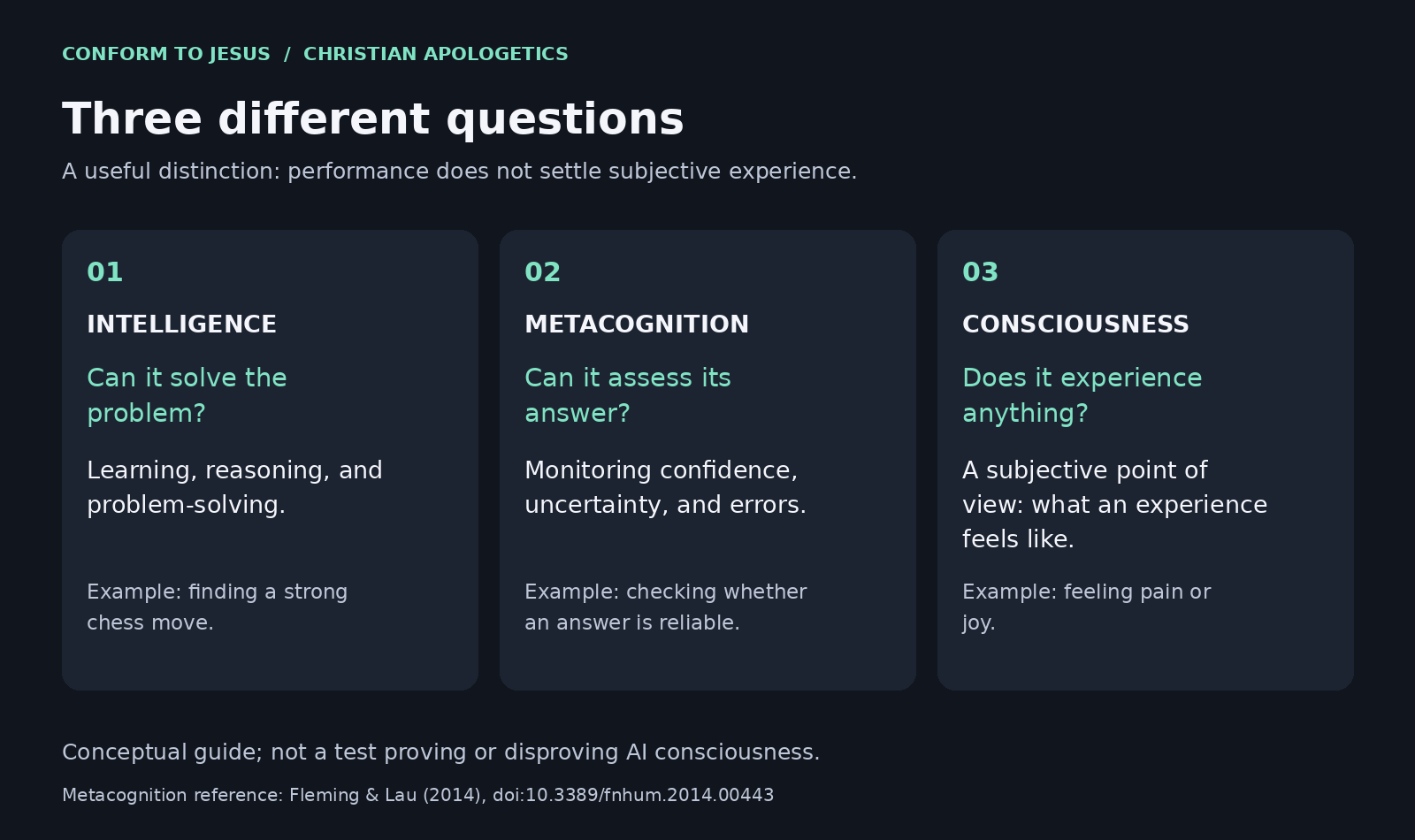
These capacities may overlap, but demonstrating one does not automatically establish the others. Researchers studying metacognition can measure how well confidence corresponds to accuracy. Such measurements help us understand self-monitoring, but do not by themselves settle whether a system has subjective experience. Fleming and Lau’s review (2014) explains the methods and their limitations.
An AI might correctly identify an error or produce a convincing account of sadness. We still need to ask whether there is an experiencing subject behind its words. That question cannot be settled merely by how natural the conversation sounds.
Knowing About an Experience and Having It
Consider soccer. Someone could study the rules, tactics, and physics involved in curving a free kick. They could explain the angle of contact, the ball’s rotation, and the goalkeeper’s likely movement.
Yet knowing those facts differs from having the skill to execute the kick. Both differ from experiencing the pressure of standing over the ball while teammates depend on you. This helps illustrate why information, ability, and experience should not be treated as identical.
Philosopher Frank Jackson explored a related problem through his famous thought experiment about Mary, a scientist who knows all the physical information about color vision but has lived in a black-and-white environment. When she first sees color, does she learn something?
Jackson’s original argument says that she does: she discovers what seeing color is like. The argument challenges whether a complete physical description captures everything about experience. It remains contested; the thought experiment is not a scientific demonstration of an immaterial soul. See “Epiphenomenal Qualia” (1982).
My soccer example likewise does not prove that experience lies outside the physical world. Acquiring a skill or encountering something new can involve changes in a physical brain. What it does show is why a description of experience should not casually be mistaken for the experience itself.
Does Brain Activity Explain the Whole Experience?
When I love my children, my brain and body are involved. Memory, attention, hormones, and bodily responses contribute to that relationship. I accept that physical reality. My question is whether describing those processes fully explains what loving them feels like.
David Chalmers calls the problem of explaining subjective experience the “hard problem” of consciousness. We can investigate how a system processes information and produces behavior while still asking why those processes are accompanied by an inner experience. See “Facing Up to the Problem of Consciousness” (1995).
Other philosophers challenge this framing. Daniel Dennett argues that explaining the mechanisms behind our judgments, reports, and responses offers a route toward understanding consciousness without accepting the hard problem as Chalmers presents it. A serious Christian discussion should engage that position rather than dismissing it. See “Facing up to the hard question of consciousness” (2018).
Neuroscience also cautions against simplistic claims. The amygdala is involved in threat processing, but describing it as the place “where fear lives” is inadequate. LeDoux and Pine (2016) distinguish defensive responses from conscious feelings of fear. Their framework illustrates the complexity of relating brain mechanisms to experience; it does not establish a supernatural explanation.
A Real Experiment: Fear Despite Amygdala Damage
In a small study, Feinstein and colleagues tested three people with bilateral amygdala damage and twelve neurologically intact comparison participants. After the first 35% carbon dioxide inhalation challenge, all three patients experienced panic attacks, compared with three of the twelve comparison participants.
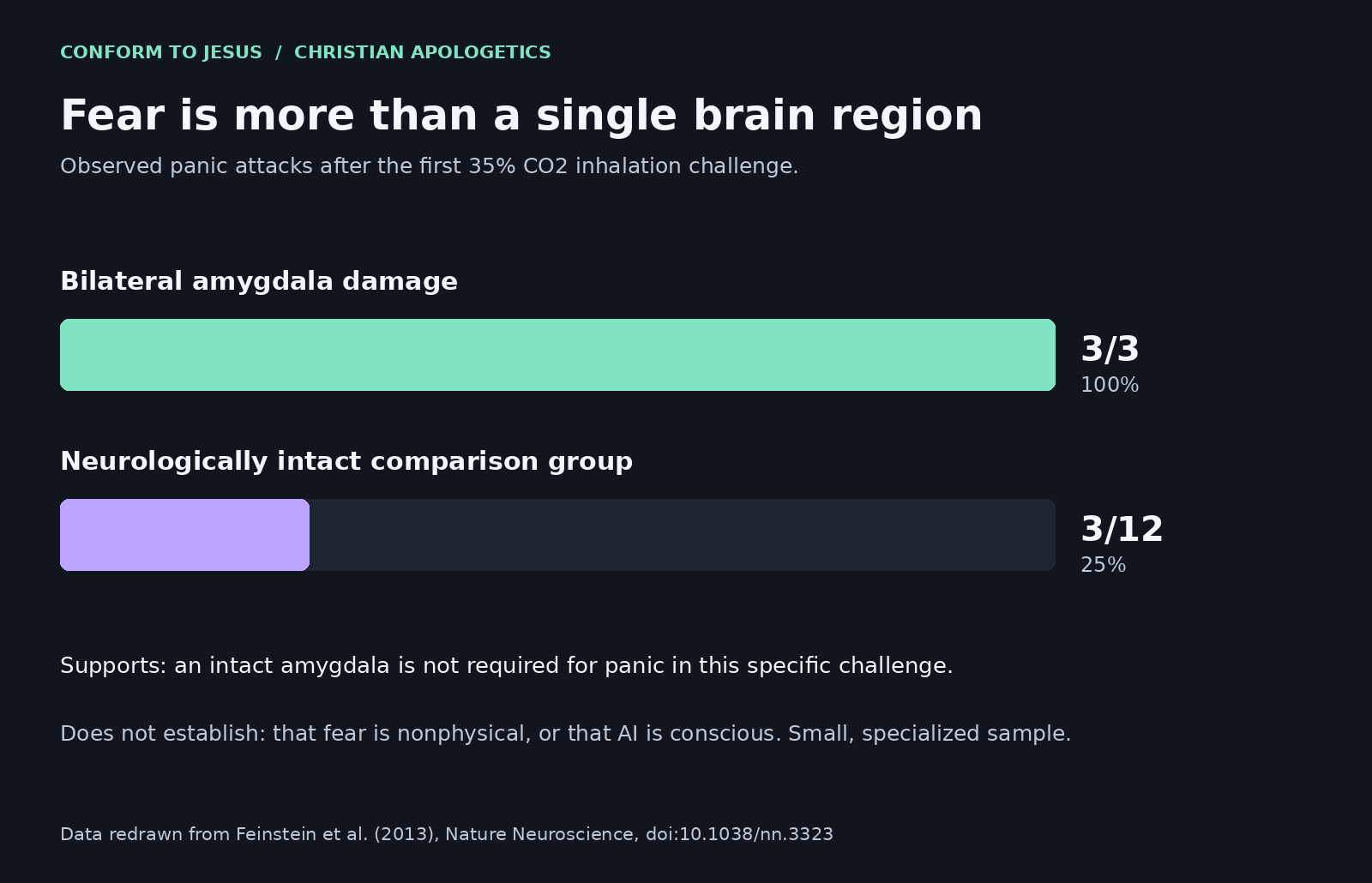
The finding challenges the simple claim that an intact amygdala is always necessary for fear or panic. It does not prove that emotion is nonphysical, identify a soul, or establish consciousness in AI. Distinguishing the result from those larger claims is part of using scholarship responsibly.
Nor does the fact that love has no weight prove that it is nonphysical. Many physical properties are not things we weigh. The more substantial question is whether measurements of emotion exhaust its meaning and lived reality.
We should not turn an unanswered question into a premature proof of God. We should also avoid treating a disputed philosophical account as though science has settled every question about personhood.
An Embodied Christian Understanding of Humanity
I do not picture my spiritual life as a passenger loosely attached to my body. My physical, emotional, intellectual, and spiritual life belong together.
Genesis 2:7 describes God forming the human being from the ground, giving the breath of life, and the man becoming a living soul. The passage directs our attention toward a living, embodied person. It does not, by itself, settle every later debate about the soul.
Christians have developed different accounts of this unity. Nancey Murphy defends nonreductive physicalism: an account of humans as physical organisms that resists reducing personal life to descriptions of individual physical components. Another tradition, hylomorphism, understands body and soul as constituting one living being, with the soul as the body’s form. These positions differ substantially, but both take embodied unity seriously.
I am still working through the terminology. My conviction is that our relationship with God concerns the whole person. This means my argument should not depend on claiming that everything physical is spiritually insignificant. Christian faith gives us reasons to take bodily life seriously.
Human Worth Cannot Be a Performance Score
Genesis 1:27 grounds human identity in being created in God’s image. It does not assign greater dignity to those with greater intellectual ability.
That matters in an age when machines can outperform people at particular tasks. If intelligence determined intrinsic worth, the more intelligent person would be worth more. A person’s dignity could decline through illness, injury, or aging. I reject that conclusion.
An AI becoming better at writing would not make a writer less human. A system becoming better at diagnosis would not diminish a patient’s worth. Productivity cannot serve as the measure of a person. Whatever future discoveries may reveal about artificial consciousness, they cannot take away the dignity God has given human beings.
Conscience: More Than Getting the Answer Right
A real estate experience helped me think about moral responsibility. While listing a home, I became aware of a leak. The sellers wanted to repair and paint over the affected area without drawing attention to it. They worried that acknowledging the problem could affect the price.
I understood their concern, but I believed we needed to be honest about what we knew and explain any repairs. Honesty could also protect everyone from future disputes. Yet my conviction went deeper than avoiding consequences.
Suppose concealment would never be discovered. Suppose it brought no financial loss, punishment, or feeling of guilt. Would knowingly misleading the buyer become acceptable? I believe it would still be wrong. The buyer is a person owed honest treatment. That obligation does not disappear when deception becomes profitable.
Romans 2:15 describes conscience bearing witness and thoughts accusing or defending a person. This provides a biblical account of inward moral self-evaluation, though it does not imply that every judgment of conscience is accurate.
Believers can suppress conscience; unbelievers can show profound integrity. The question is not who can behave morally. It is what grounds our obligations. My Christian answer is that moral responsibility is grounded in the character of a personal, holy Creator.
Giving Skeptics a Fair Hearing
A skeptic might agree that deception is wrong while rejecting my explanation of why. Some nonreligious philosophers defend objective moral truths. Russ Shafer-Landau, for example, argues for moral realism. Christianity and relativism are therefore not the only positions available.
We should also avoid assuming that an analytical approach to ethics necessarily permits deception. Utilitarianism evaluates consequences for overall well-being, rather than simply personal advantage. John Stuart Mill explicitly defended truthfulness because deception undermines the trust on which society depends.
An AI could produce arguments about duties, consequences, or virtuous character. The unresolved issue is whether producing those arguments amounts to experiencing moral obligation or bearing responsibility. My experience of conscience gives us something to explain. It does not independently prove that machines could never have moral agency.
Could Artificial Consciousness Arise?
My honest answer is that I do not know. I cannot rule out every possible future system. Nor do I think consciousness follows automatically from greater intelligence.
Researchers are developing ways to assess potential AI consciousness using indicators derived from scientific theories. Butlin and colleagues’ work on consciousness indicators emphasizes uncertainty and the need for more rigorous assessment. It does not provide a simple test establishing that fluent conversation equals conscious life.
Reports of systems resisting shutdown also require care. In Anthropic’s 2025 controlled simulations, researchers stress-tested sixteen models in fictional corporate settings involving replacement threats or goal conflicts. Some models took harmful actions. These were constructed evaluations, not observations that an AI felt fear.
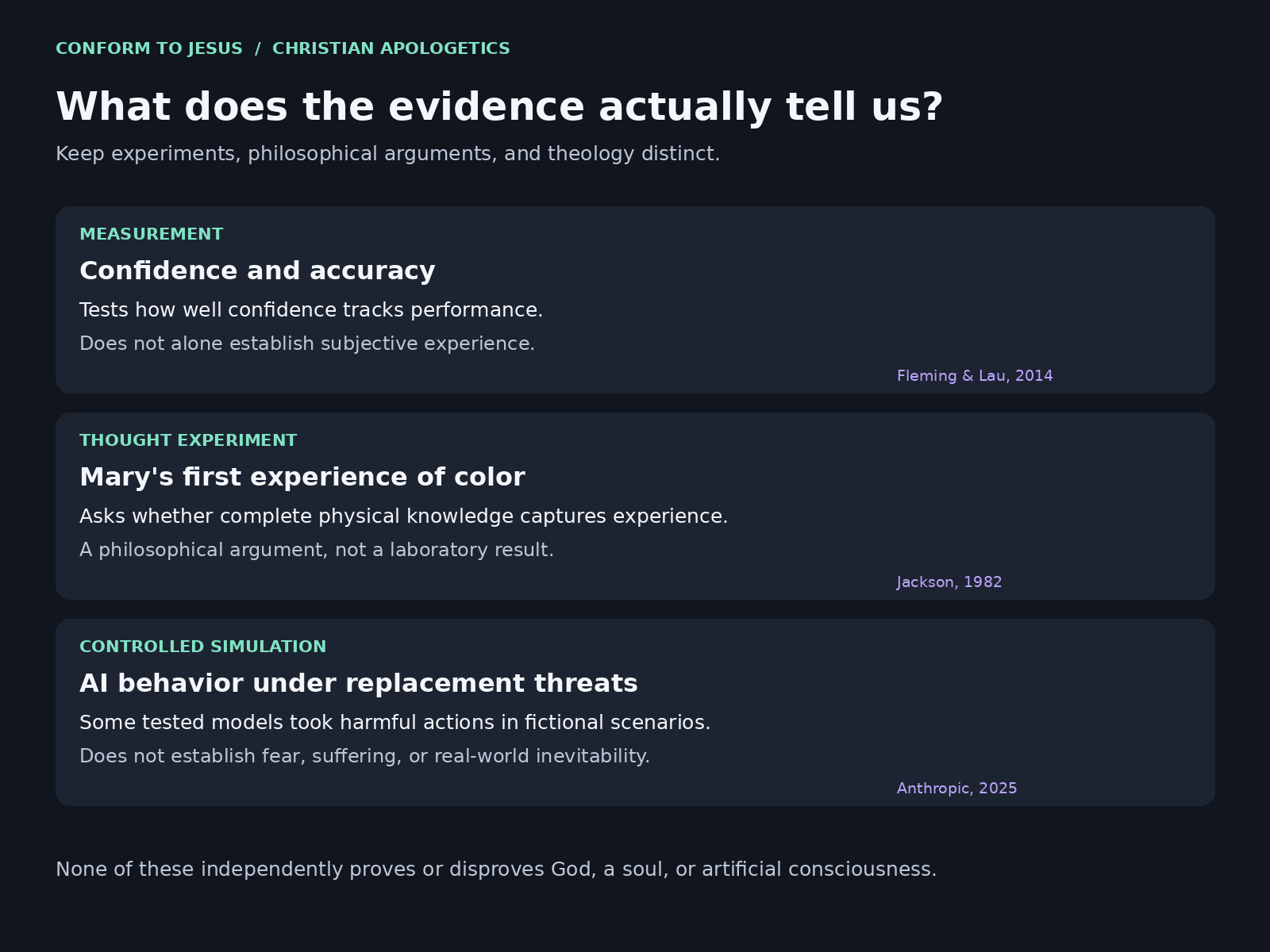
Such behavior does not establish fear: remaining operational could serve a goal without any accompanying experience of distress. These tests help assess behavior and risk; they do not settle consciousness.
Consciousness, biological life, and human identity are separate questions. Even evidence for artificial consciousness would not automatically establish that a system is alive in the biological sense or is human. Acknowledging these distinctions is part of taking the subject seriously.
Babel, Power, and the Limits of Our Wisdom
My concern about AI is not limited to consciousness. A system need not feel anything to become dangerous through misuse, excessive autonomy, or the authority people give it.
Babel offers a theological analogy. The builders seek to make a name for themselves through a collective project. The passage does not directly condemn technological invention, but it invites us to examine ambition, pride, and the pursuit of security through our own power.
Are we creating tools to serve our neighbors? Are we willing to accept limits? Or might we mistake superior performance for rightful authority?
A system could produce an answer we struggle to understand. Sometimes we might independently verify it; at other times we could not. We should not call something true merely because an impressive machine asserts it.
Likewise, greater intelligence does not automatically produce control. Access, autonomy, infrastructure, and human decisions matter. The International AI Safety Report 2026 treats possible loss of control as a serious research question while emphasizing uncertainty about future developments. Domination is not an established or inevitable outcome.
What Remains Special About Us?
I finish this conversation with convictions and open questions. I believe humans possess God-given dignity that no machine’s performance can diminish. I believe we owe one another truthful, responsible treatment, even when dishonesty would benefit us. I understand our spiritual lives as deeply connected with our embodied existence.
I remain uncertain about whether artificial consciousness could arise. That uncertainty does not require fear or careless optimism. It calls for humility, careful investigation, and responsibility.
The Christian question reaches beyond whether we can build something more intelligent than ourselves. It asks what kind of people we become through building it—and whether our growing power remains directed toward love of God and neighbor.
Sources and Further Reading
Primary research and philosophical works are linked beside the relevant claims. The fear chart presents reported experimental counts; the other two graphics are explanatory guides, not experimental datasets. The featured image is a conceptual illustration.
Fleming & Lau (2014), How to measure metacognition
Jackson (1982), Epiphenomenal Qualia
Chalmers (1995), Facing Up to the Problem of Consciousness
Dennett (2018), Facing up to the hard question of consciousness
Feinstein et al. (2013), Fear and panic in humans with bilateral amygdala damage
LeDoux & Pine (2016), A Two-System Framework
Murphy (2013), Do Humans Have Souls?
Butlin et al., Identifying indicators of consciousness in AI systems
Anthropic (2025), Agentic misalignment
International AI Safety Report 2026


Leave a Reply