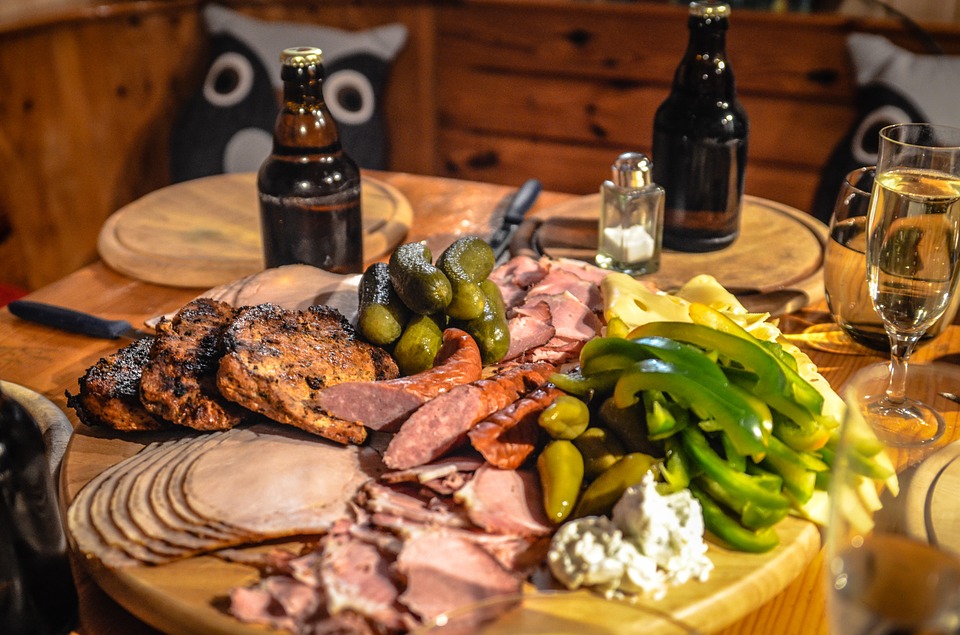

It is crucial to note that God’s first commandments to humans were related to eating. The Hebrew word “command” is used for the first time in Genesis 2:16-17 to reflect God’s headship over creation.
While God gave Adam and Eve dominion over the created order, He still set “boundaries” when He said—the tree of the knowledge of good and evil you shall not eat.
This is a pivotal point. Eve really ate a forbidden fruit. The physical reality of eating something that God has “declared” forbidden is linked to the spiritual reality of disobedience to God.
If this interpretation was strictly to convey a moral point, then why not turn the entire story into an allegorical lesson? Because you and I both know it’s critical to believe in a literal Eden, a literal tree, and a literal fall of man or otherwise the historical-redemptive piece is missing from the Bible.

It is correct to say the original Edenic diet assigned to man consisted of fruits, nuts, grains, and vegetables (Gen. 1:29-30; 2:9; 3:2).
That being said, God was the first to kill an animal in order to clothe Adam and Eve for the purpose of keeping them warm and more importantly, to demonstrate without the shedding of blood, there is no forgiveness (Heb. 9:22).
It was also Abel’s sacrifice of meat in Genesis 4:4 that was acceptable and pleasing to God, not the fruit of the ground brought by Cain (Gen. 4:3). The main focus was the sacrifice, but that doesn’t mean meat was forbidden in God’s original plan.
I believe God always intended for meat to be eaten, and he would later differentiate between clean/unclean in Noah’s time based on Genesis 7-9.
Regardless of whether meat was eaten or not in the garden, the distinction between clean and unclean animals was still made before the more specific covenantal stipulations with Israel at Sinai.

Thus, dietary restrictions are not embedded in the socio-cultural context of the Isrealites, but is rather a subset of the clean/unclean distinction as a meta-narrative of the entire Bible.
Therefore, when theologians associate circumcision with the dietary restrictions, they are committing the fallacy of false equivalence.
First, circumcision was deeply embedded in the ceremonial law. One could not come to the temple if they weren’t circumcised. It was also a sign of their “distinction” from the pagan nations. But the separation from Pagan nations rationale doesn’t work with the clean/unclean animals.
For instance, W.F. Albright points out in his book, “Yahweh and the Gods of Canaan,” that large and small cattle were more generally sacred, so that it is quite irrational to single out the economically and religiously much less important pig and to explain its prohibition in Israel by its alleged religious significance.”
Additionally, a comparison between Leviticus 11 and Deuteronomy 14 demonstrates that the repetition of the dietary code in Deuteronomy 14 is free from ceremonial or ritual regulations connected to the sanctuary or holy place.
Also, out of all the eleven kinds of uncleanness that are classified in Leviticus (uncleanness of child birth, mildew in clothing or in house, leprosy, etc) all of them are temporary. Some are 1 day, 7 days, 33 days, etc). The uncleanness of animals, however is permanent (Gen. 7:2; Lev. 11:1-47; Deut. 14:3-21).
This means an unclean animal is born unclean and dies unclean. As one scholar pointed out, “the type of uncleanness is hereditary, non-cultic, and universal, while the other kind is acquired, temporary, and ritual/ceremonial.” In fact, the dietary regulations were required for the “sojourner” in Leviticus 17:3 through the law of hunting.
Skeptics argue there are no positive evidence existing in the form of commandments or prohibitions prior to the book of Leviticus to support such a standard. First, let me point out that God still punished Cain for murdering his brotherAbel prior to the 10 commandments. Scripture makes it clear that the law of God is written on our hearts (Rom. 2:15).
In fact, God’s invisible attributes are clearly seen in “nature” so that all are without excuse. Secondly, I disagree. If you read Leviticus 11, it is connected theologically with the Exodus from Egypt in terms of motivation for its observation.
Recall that Exodus 20:2 starts with “I am the Lord your God, who brought you out of the land of Egypt,” The same terminology is used in Lev. 11:43 “You shall not defile yourselves with any swarming thing that crawls upon the earth. For I am the Lord who brought you up out of the land of Egypt to be your God; you shall therefore be holy, for I am holy.”
Here cleanness and holiness are linked with redemption from the slavery and bondage in Egypt.
Moreover, God links Leviticus 20:22-26 in connection with the gift of the land. “You shall inherit their land, and I will give it to you to possess, a land flowing with milk and honey. You shall therefore separate the clean beast from the unclean, and the unclean bird from the clean.
You shall not make yourselves “detestable by beat or by bird or anything which the ground crawls, for I have set apart for you to hold unclean…” The appeal to following the laws of the land are connected with future blessing.
Another objection raised was that if one applies the dietary regulations then do they have to apply the entire book of Leviticus? First, the idea of unclean/clean is not limited to the book of Leviticus. Yes, the specific command is, but the motivation and themes are represented throughout the entire Bible, from Genesis 1 to Revelation.
Second, why is it that people hastily jump to the conclusion that the laws in Leviticus are arbitrary? Do you think God would create “revelational” laws in contrast with “rational” laws which man can better understand?
Remember Leviticus also condemned prostitution, bestiality, and other abominations that Christians reject as well. As far as the mold, how do you know whether God was trying to protect his people from infection? If you want to do extensive research, look up D.I Macht, “A Scientific Appreciation of Leviticus 11 and Deuteronomy 14.
The key is really to look at the passages in the New Testament to see if God’s commandments concerning clean/unclean animals have been abolished. First, the Mark 7 passage is mentioned to argue God abolished the old testament dietary law.
Subscribe to get access
Read more of this content when you subscribe today.
 Conform to Jesus
This is the best article of explanation of clean food laws I’ve ever read.
Thank you for breaking it down into understandable language.
Shalom
LikeLike
Thanks for your comment Wanda. Continue to be a Berean. Shalom!
LikeLike
Hi, where do you find a Christian church that follows Old Testament laws? Do you follow ALL of the laws? What church do you attend that goes to services on Saturday? I’m learning a lot here. Thank you.
LikeLike
Robbyn, thank you so much for reading my article. I currently attend a Messianic Jewish synagogue. We keep the Sabbath, dietary laws, and also follow the Jewish festivals, such as Yom Kippur, Pesach (Passover), Purim, Rosh Hashanah, etc.
Jesus, who was an observant Jew, said, “Do not think that I came to abolish the law. I did not come to abolish but to fulfill it.” Furthermore, as a Messianic Jew, I believe Jesus was the Messiah, the Son of God, who came to atone for the sins of the world.
Thus, I don’t believe we obey God’s laws to be saved. Rather, because we are saved by grace through faith in Jesus (Eph. 2:8-9), we obey God’s Word. For Jesus told us: “If you love me, you will obey my commands.”
I think this is very important because “works of the law” do not save us. Only the righteousness of Christ. I have the same view here as a mainline Protestant concerning salvation. It is a free gift, not by works.
I hope I answered your questions. If you want to know more about Messianic Judaism, I wrote an article entitled: “What Does The Bible Say About Messianic Judaism?” Have a blessed day!
LikeLike
Why not follow ALL of the Jewish laws? I’m so confused as to why some would be followed and others not be followed. How do you determine which Jewish laws get observed. I’m not being argumentative. I truly want to know and understand. Thank you so much for your help. God bless you.
LikeLike