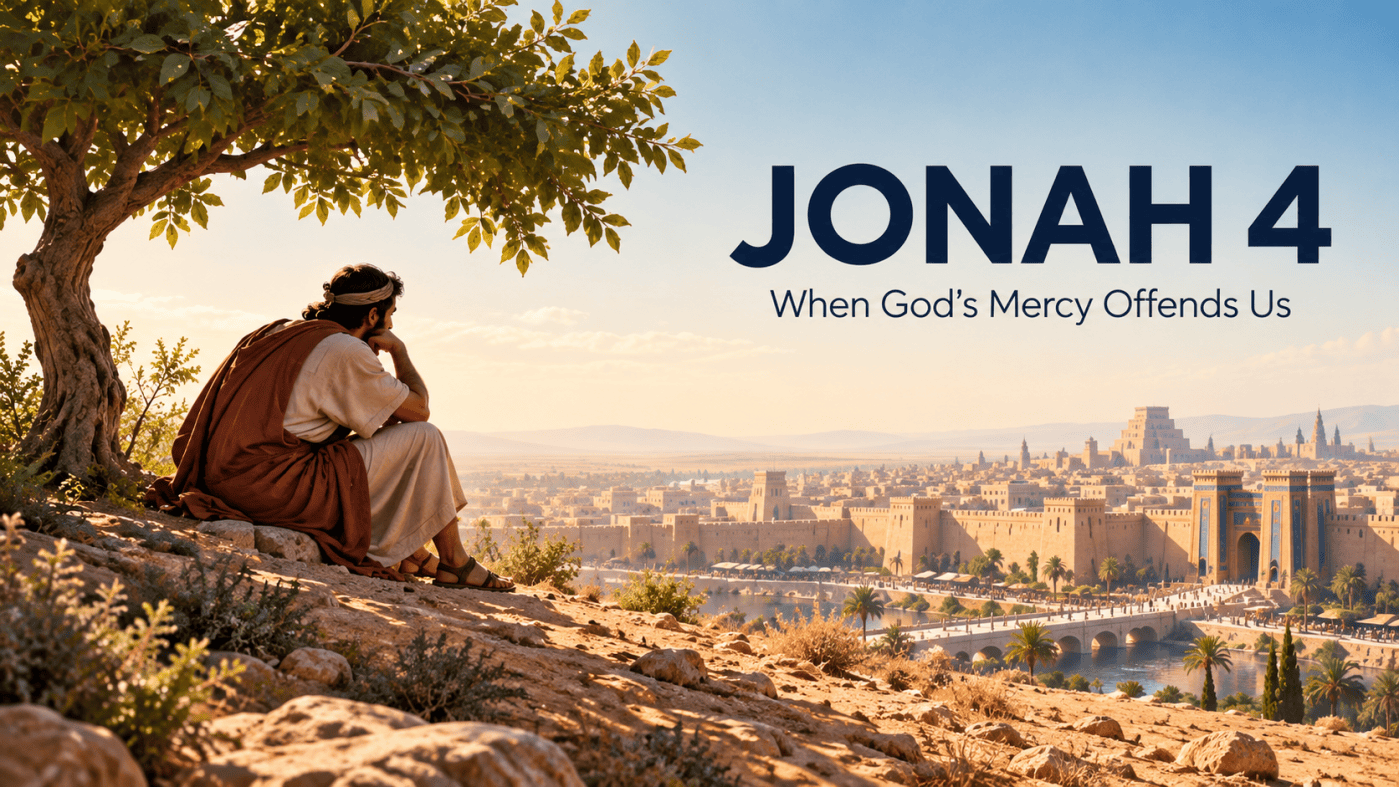
Learning to love the people God refuses to abandon
Sometimes our greatest struggle is not believing that God is merciful. It is accepting the people to whom He chooses to show mercy.
We welcome His patience when we fail. We are grateful that our worst moment does not have to become the final word over our lives. Yet when someone has hurt us, disappointed us, or lived in ways we know are wrong, we can want a different outcome for them.
Mercy for me. Judgment for them.
Jonah 4 brings that uncomfortable contradiction into the light. Nineveh has responded to God’s warning, and God has spared the city. We might expect the prophet to celebrate. Instead, he becomes angry. The final chapter turns our attention from a city that needed repentance to a prophet whose heart still needed changing.
As we read, we should resist the temptation to stand above Jonah. There is something of Jonah in all of us.
1. When mercy feels like the wrong outcome — Jonah 4:1–3
Jonah is deeply displeased that Nineveh has been spared. In his prayer, he explains that this possibility was precisely why he fled toward Tarshish. He knew that God was gracious, merciful, slow to anger, and abundant in loving kindness.
These are not unfamiliar truths. His confession echoes God’s revelation of His character in Exodus 34:6–7. Jonah knows the theology. His difficulty is living in agreement with it.
The Hebrew language sharpens the irony. The word family associated with evil, calamity, and distress runs through the account: Nineveh turns from its evil, God relents from the announced calamity, and Jonah regards the outcome with intense displeasure. The same language helps expose a prophet whose response is out of step with God’s compassion.
Nineveh was an Assyrian city, not simply an inconvenient group of strangers. Scripture does not minimize its wickedness or the violence from which its people were called to turn (Jonah 3:8). We should not reduce Jonah’s anger to ordinary jealousy. Nevertheless, his response exposes something we recognize in ourselves: we can resent God’s generosity toward other people.
I think we experience this when we see God working in someone else’s life. Instead of rejoicing, we compare. We wonder why they are succeeding, why their ministry is growing, or why God would forgive them after what they have done. Our fallen nature can turn another person’s blessing into a reason for envy.
Being created in God’s image helps explain why justice matters to us. But being fallen means our judgments are not automatically pure. A genuine concern for righteousness can become mixed with pride, resentment, and self-interest.
We want people held accountable. That can be right. But are we equally willing to have our own hearts examined?
God’s mercy does not declare evil good. In the preceding chapter, the Ninevites turn from their evil ways. The warning becomes the occasion for repentance rather than destruction. Jonah objects to the mercy he himself has already needed.
The mercy double standard
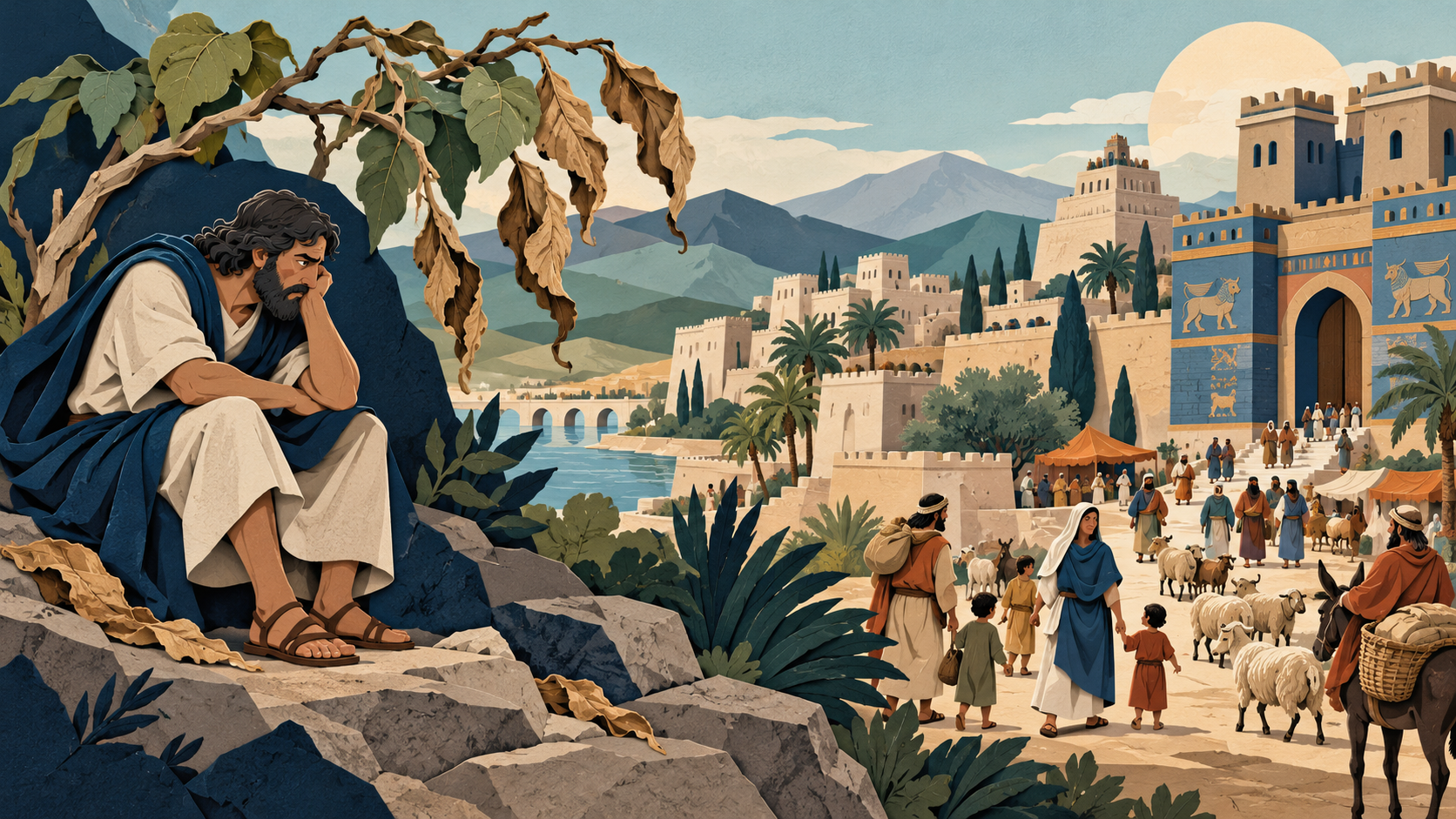
A plant mattered deeply to Jonah. God asked him to consider the lives within an entire city. Symbolic illustration of Jonah 4:9–11.
| When I look at myself | When I look at someone I resent | The question grace asks |
|---|---|---|
| “Please be patient with me.” | “Why are they getting another chance?” | Will I welcome patience for them too? |
| “You know my struggles.” | “They should know better.” | Am I judging with humility? |
| “Thank You for blessing me.” | “Why is their life going so well?” | Can I rejoice without comparing? |
| “Forgive what I have done.” | “They should get what they deserve.” | Have I forgotten that mercy is a gift? |
Reflection: A concern for justice should lead us toward truth and humility, not delight in another person’s destruction.
2. God’s question reaches beneath our anger — Jonah 4:4
God asks Jonah whether it is right for him to be angry. He does not flatter Jonah’s resentment, but neither does He end the conversation. He addresses him.
There is patience in that question. God is not only dealing with Nineveh. He is dealing with His servant.
I recognize something of this in my own calling. I know God has called me to write and share the gospel. Yet there are times when I step back, become busy, and focus my attention elsewhere. Rest is not automatically disobedience, and caring for a family is not a distraction from faithfulness. But I have to be honest about the difference between needed rest and avoiding something God has called me to do.
Sin can deepen that avoidance. We do not want to be reminded that something needs to change, so we try to hide from conviction. We stay occupied. We postpone prayer. We tell ourselves we will respond later.
Yet God has used people to draw me back. A friend serving as a missionary across the world has reminded me of God’s faithfulness—of the truth that He will not leave or forsake His people. Sometimes a conversation brings us back to what we already know but have stopped living out.
Humbling circumstances can do this too. Hardship can interrupt the illusion that we are in control and remind us to repent and trust Jesus. That does not mean every tragedy is punishment for a particular sin. We should never place that burden on someone’s suffering. It means God can meet us in circumstances we would not have chosen and use them to turn our attention toward Him.
I have sometimes wondered, “Why are You still being so patient with me? I have failed so many times.”
His patience is not permission to remain unchanged. It is kindness that invites us to return (Romans 2:4). Jonah’s anger does not prevent God from speaking to him. Our failures should not persuade us that returning to God is pointless.
3. The plant exposes what Jonah values — Jonah 4:5–8
Jonah goes outside the city, makes a shelter, and waits to see what will happen. God appoints a plant that provides shade, and Jonah becomes exceedingly glad. Then God appoints a worm that damages the plant. When the sun rises, He appoints a scorching east wind, and Jonah becomes faint and again wishes to die.
The repeated language of God’s appointment connects these events with the great fish earlier in the book. The creature that rescued Jonah and the circumstances that now unsettle him are not beyond God’s sovereignty.
The Hebrew name for the plant is qiqayon. Its precise botanical identity is debated; the lesson does not depend on identifying its species. What matters is that it provides relief Jonah did not produce and then becomes the focus of his intense attachment.
Jonah rejoices over shade while struggling to rejoice over a spared city.
That contrast asks us to examine our priorities. How much of our emotional life revolves around protecting our comfort? What disturbs us more: an inconvenience to our plans or the spiritual condition of people around us?
I experienced a smaller, everyday version of that tension when supporting a missionary preparing for important work in several places across Asia. He hoped to reach thousands of people. I initially gave $500, but I sensed that I was holding back.
We have a large family and real expenses. Providing for them and keeping financial reserves are good responsibilities. This was not a lesson that caring for my household was wrong. It was a question about my own grip on security.
After a conversation with my friend, I felt led by the Holy Spirit to give another $500. I experienced the prompting less as condemnation and more as an invitation: “Isn’t this exciting? Give. Be a cheerful giver.”
I decided to give the additional amount.

From holding back to participating with joy: generosity is an invitation, not a formula. Symbolic artwork, not a depiction of the missionary or his actual work.
The point is not that $500 was inadequate or that someone else needs to give $1,000. This is my testimony, not a formula for another family’s finances. Second Corinthians 9:7 emphasizes willing, cheerful giving rather than compulsion. What changed was my willingness to participate joyfully in what God was doing.
Sometimes the question is not whether something is valuable. We already know it is. The question is whether we will let that value reshape our priorities.
From protecting comfort to participating in mercy
| Moment | In Jonah’s story | A question for us |
|---|---|---|
| A gift received | Shade brings Jonah great joy. | What good gift have I begun to treat as an entitlement? |
| A comfort threatened | The plant withers; Jonah becomes angry. | What does my reaction reveal about what I treasure? |
| A heart examined | God asks about Jonah’s anger. | Am I willing to listen rather than defend myself? |
| A wider concern revealed | God directs attention to Nineveh’s people and animals. | Whose needs have fallen outside my concern? |
| A response invited | The chapter closes without Jonah’s answer. | What faithful step can I take today? |
Application, not a financial formula: Faithfulness may involve generosity, service, reconciliation, or renewed obedience. It does not require neglecting legitimate responsibilities.
4. God sees a city where Jonah sees an objection — Jonah 4:9–11
God again questions Jonah’s anger, this time concerning the plant. Jonah insists that his anger is justified. God then points out that Jonah is concerned about a plant he neither cultivated nor caused to grow. Should God not have concern for Nineveh?
The contrast moves from the lesser to the greater: a short-lived plant and a great city filled with living creatures.
God mentions more than 120,000 people who cannot distinguish their right hand from their left. Interpreters differ over whether this refers especially to young children or describes the people’s lack of discernment more broadly. We should acknowledge the uncertainty rather than build a confident population estimate on the phrase. Either way, God sees human need that Jonah’s anger has obscured.
The final mention of animals widens the picture further. God’s concern is not abstract. The city contains lives, households, vulnerable people, and creatures dependent on His care.
Jonah sees the city through the lens of his grievance. God insists that he look again.
We must do the same. People are not merely categories, opponents, or reminders of what they have done wrong. They bear God’s image. Recognizing their humanity does not remove accountability or require us to abandon wise boundaries. Forgiveness does not mean concealing abuse, preventing justice, or immediately restoring trust. But neither should accountability become an excuse to wish people beyond the reach of repentance and mercy.
Jesus calls us to love our enemies and pray for those who persecute us (Matthew 5:44). That command challenges the part of us that wants grace to stop at the edge of our own circle.
5. The unanswered question becomes our invitation

How will you respond to God’s mercy? The book leaves Jonah’s answer unrecorded and invites us to examine our own. Symbolic illustration, not a claim about what Jonah did next.
Jonah ends without recording the prophet’s response. We are not told whether he finally agrees with God. The question remains before us.
In one sense, we have to finish the story—not by adding to Scripture, but by living out our answer.
The Bible gives us truthful accounts of people whose lives reveal God’s sovereignty, holiness, and mercy. We are meant to learn from them. We can admire the lesson and leave our lives unchanged, or we can respond to what God is showing us.
Will we rejoice when someone repents? Will we return to a calling we have avoided? Will we surrender resentment, give cheerfully, or offer help without needing to be the center of the story?
God remains the sovereign author of history. Our calling is not to control His mercy but to obey Him within the lives He has given us.
We are not asked to write another verse of Jonah. We are asked to live out our answer to God’s question.
6. We cannot hide from God—and we do not have to earn our way back
There is something of Jonah in every one of us. We disobey. We run. We try to hide from conviction.
But God is omniscient: He knows everything. He is omnipresent: no place lies beyond His presence. Psalm 139 describes the impossibility of escaping Him, whether in the heights, in Sheol, or beyond the sea. Jonah’s prayer from the great fish likewise testifies that the depths did not prevent God from hearing him.
People sometimes try to numb pain through alcohol, drugs, constant activity, or other forms of escape. These struggles deserve compassion, not easy condemnation; addiction can also require professional treatment and practical support. But no escape can make us unknown to God. He knows where we are, including when we do not know how to find our way forward.
The invitation is to repent and trust His Son, Jesus Christ, for the forgiveness of sins. Jesus identifies Himself as the way to the Father (John 14:6). We do not return by building a record impressive enough to outweigh our failures.
Ephesians 2:8–9 teaches that salvation is by grace through faith, God’s gift rather than the result of works. That leaves no room for boasting. Our obedience is the fruit of grace, not the price we pay to obtain it (Ephesians 2:10).
And in Jesus, justice and mercy are not enemies. God does not simply overlook sin. Through Christ’s saving work, He remains just while justifying the person who has faith in Jesus (Romans 3:25–26).
Jonah reluctantly carries a warning to people he resents. Jesus willingly gives Himself for sinners. The One greater than Jonah does not merely tell us about mercy; He makes our reconciliation with God possible (Matthew 12:41; Romans 5:8).
Jesus is the One who heals us. That does not promise an immediate end to every illness or struggle. It means our deepest restoration begins with Him: forgiveness, reconciliation, and a heart being renewed by grace.
If you recognize yourself in Jonah, do not make your failure another reason to hide. Bring Him the resentment. Bring Him the fear. Bring Him the reluctance to obey.
The mercy that offended Jonah is the mercy we desperately need.
And the question remains: will we receive it with gratitude—and rejoice when God extends it to someone else?
A prayer
Father, thank You for Your patience with me. Forgive me for wanting mercy for myself while withholding compassion from others. Show me where pride, resentment, or the desire for comfort has shaped my response to You. Help me provide faithfully for those entrusted to me while remaining generous and willing to serve. Draw me back when I hide, and teach me to rejoice when others receive Your grace. I cannot earn Your forgiveness. I trust Jesus Christ, who gave Himself for sinners. Make my life an obedient response to Your mercy. In Jesus’ name, amen.


Leave a Reply