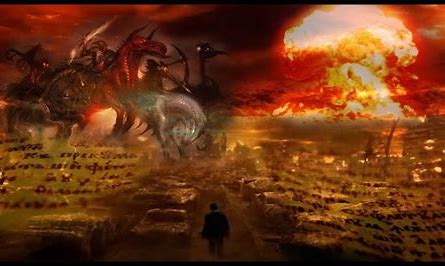
The book of Revelation, often regarded as a complex and symbolic text, contains various visions that depict the culmination of human history and the ultimate triumph of good over evil.
Revelation 11 is a chapter that presents the vision of the two witnesses and the sounding of the seventh trumpet. Here is a commentary on Revelation 11 along with each verse from the World English Bible:
Revelation 11:1-2 (WEB)
“A reed like a rod was given to me. Someone said, ‘Rise, and measure God’s temple, and the altar, and those who worship in it. Leave out the court, which is outside of the temple, and don’t measure it, for it has been given to the nations. They will tread the holy city under foot for forty-two months.'”
In these opening verses, the scene is set for a measurement of the temple. The act of measuring can symbolize divine protection and ownership. The exclusion of the outer court suggests a period of trial and tribulation for the people of God. The mention of forty-two months echoes a period of testing and trial, which is often associated with the concept of a limited and defined time of hardship.
Some scholars view the act of measuring the temple as a symbolic gesture rather than a literal survey. The temple is seen as representing the people of God, and the measuring signifies God’s protection and ownership of His faithful. This perspective emphasizes the spiritual significance of the temple rather than a literal, earthly structure.
Others place the events in the historical context of the Roman Empire’s influence on Jerusalem. The outer court, left unmeasured and given to the nations, could symbolize the period of Roman dominance and the subsequent desecration of Jerusalem. The measured temple may then represent the preservation of the faithful remnant.
Currently, ever since the temple was destroyed in AD 70 in Jerusalem, it hasn’t been rebuilt. However, there are scholars who believe that this temple could be rebuilt in the future right before the second coming of Christ.
In 1948, for the first time in 2,000 years, Israel became a Jewish state and received their land back after World War II. This was a crucial prophetic fulfillment that I believe will usher in the last days, when God’s people will rebuild the temple before the second coming of Jesus.
Revelation 11:3-6 (WEB)
“I will give power to my two witnesses, and they will prophesy one thousand two hundred sixty days, clothed in sackcloth. These are the two olive trees and the two lampstands, standing before the Lord of the earth. If anyone desires to harm them, fire proceeds out of their mouth and devours their enemies. If anyone desires to harm them, he must be killed in this way.”
The introduction of the two witnesses, often interpreted as symbolic figures, highlights a period of prophetic testimony. The use of the imagery of olive trees and lampstands connects them with divine anointing and illumination.
The supernatural protection granted to them, with the ability to consume their enemies with fire, underscores the divine authority behind their mission. God is oftentimes described as a consuming fire, and the Bible says in Zechariah 2:5, “And I myself will be a wall of fire around it,’ declares the LORD, ‘and I will be its glory within.’
Many scholars see the two witnesses as symbolic figures rather than literal individuals. The symbolism often draws connections to Old Testament figures such as Moses and Elijah, representing the Law and the Prophets, or to the church as the ongoing witness of God in the world.
Some interpretations identify the two witnesses as Moses and Elijah, pointing to their appearance with Jesus during the Transfiguration (Matthew 17:1-13). This view emphasizes the continuity between the Old and New Testaments and sees the witnesses as representing the entire scope of God’s revelation.
There are also believers who think this specific verse is speaking to two prophetic individuals who have an eschatological role in the end of days. They will be given special power to preach the gospel of Christ to the whole world and have 3 1/2 years to spread God’s righteousness and kingdom to every tribe, tongue, and nation.
Revelation 11:7-10 (WEB)
“When they have finished their testimony, the beast that comes up out of the abyss will make war with them, and overcome them, and kill them. Their dead bodies will be in the street of the great city, which spiritually is called Sodom and Egypt, where also their Lord was crucified. From among the peoples, tribes, languages, and nations people will look at their dead bodies for three and a half days, and will not allow their dead bodies to be laid in a tomb.”
The martyrdom of the two witnesses is depicted, symbolizing the opposition faced by those who bear witness to God’s truth. The reference to the great city, spiritually called Sodom and Egypt, suggests moral corruption and oppression. The public display of their bodies reflects a period of apparent defeat, and the refusal to bury them symbolizes the world’s rejection of their message.
Based on the description, this verse seems to be literal and not figurative in speech. The fact that the beast, who is Satan, the one roaring around like a lion, will make war with them shows an actual physical battle in nature.
You also see that these two prophets will be publicly displayed for the world to see, and when evil will be called good and good called evil, no one will mourn for these righteous witnesses. This demonstrates how reprobate the world will be immediately before the second coming of Christ.
Revelation 11:11-14 (WEB)
“After the three and a half days, the breath of life from God entered into them, and they stood on their feet. Great fear fell on those who saw them. I heard a loud voice from heaven saying to them, ‘Come up here!’ They went up into heaven in the cloud, and their enemies saw them. In that day there was a great earthquake, and a tenth of the city fell. Seven thousand people were killed in the earthquake, and the rest were terrified and gave glory to the God of heaven. The second woe is past. Behold, the third woe comes quickly.”
The resurrection and ascension of the two witnesses proclaim a triumphant victory over death. The fear that falls on those who witness this event highlights the power and authority of God.
The subsequent earthquake and its impact on the city underscore the divine judgment that accompanies these events. The acknowledgment of God’s glory by those who remain reflects a transformative impact on some hearts.
It seems to me that this is an actual event that takes place, not symbolic or figurative in nature. Why? Because “Breath of life from God entered into them,” and “They stood on their feet,” suggests a real, bodily resurrection rather than a symbolic or metaphorical one.
Moreover, the visual ascension of the two witnesses into heaven is often cited as a concrete and literal event. The explicit description of them going up into heaven in a cloud is taken as evidence for a tangible, observable occurrence rather than a symbolic representation.
Revelation 11:15-19 (WEB)
“The seventh angel sounded, and great voices in heaven followed, saying, ‘The kingdom of the world has become the Kingdom of our Lord, and of his Christ. He will reign forever and ever!’ The twenty-four elders, who sit on their thrones before God’s throne, fell on their faces and worshiped God, saying: ‘We give you thanks, Lord God, the Almighty, the one who is and who was; because you have taken your great power and reigned. The nations were angry, and your wrath came, as did the time for the dead to be judged, and to give your bondservants the prophets, their reward, as well as to the saints, and those who fear your name, to the small and the great; and to destroy those who destroy the earth.’ God’s temple that is in heaven was opened, and the ark of the Lord’s covenant was seen in his temple. Lightnings, sounds, thunders, an earthquake, and great hail followed.”
The sounding of the seventh trumpet marks a climactic moment in Revelation. The declaration of the establishment of God’s eternal kingdom signifies the ultimate fulfillment of divine purpose. The worship of the elders acknowledges God’s sovereignty and the unfolding of His plan throughout history.
The sounding of the seventh trumpet is commonly associated with eschatological events, referring to the final events in human history. Scholars often connect this trumpet blast with the end times, including the resurrection, final judgment, and the ushering in of the new heavens and new earth.
The imagery of the temple and the ark highlights the divine presence and the unveiling of God’s covenant. The cosmic disturbances that follow underscore the magnitude of these events and the cosmic significance of God’s intervention in human affairs.
The reaction of the twenty-four elders falling on their faces and worshiping God emphasizes the divine sovereignty and the significance of the moment. You can see that the nations were raging against the holy one, and God’s wrath and judgment brought righteousness and victory over sin and death.
The lightnings, thunders, and great hail is a vivid image of God’s power and glory. In the account of the giving of the Law at Mount Sinai in the book of Exodus (Exodus 19-20), there are similar elements of thunder, lightning, and a thick cloud. The people were instructed to prepare for the arrival of God, and the mountain was described as being covered with smoke like that of a furnace. The earth trembled, and there was a sound of a trumpet that grew louder and louder.
The parallel between the events described in Revelation 11 and the theophany at Mount Sinai suggests a connection between the Old Testament covenantal experiences and the apocalyptic imagery in the book of Revelation. Some scholars interpret this similarity as a way of conveying the seriousness, divine authority, and covenantal significance of the events described in Revelation. The use of such imagery emphasizes the continuity between God’s actions in history, as recorded in the Old Testament, and the fulfillment of His purposes in the apocalyptic visions of Revelation.
Conclusion
In summary, Revelation 11 portrays a vivid and symbolic narrative of prophetic witness, persecution, resurrection, and the ultimate establishment of God’s eternal kingdom. The chapter invites readers to reflect on the themes of faithfulness, divine protection, and the triumph of God’s purposes in the face of opposition and adversity.
Revelation 11 is a warning for all of us to continue repenting and trusting in Jesus for our salvation. It’s vital that we also go into all the world and preach the gospel to everyone before it’s too late. Right now, God’s grace is abundant and free to all who will call on Him. However, there is a day coming where this will all end, and God’s grace will no longer be accepted. Instead, it will be his wrath and fury.
Ultimately, Revelation 11 calls readers to contemplate the themes of faithfulness in the face of adversity, the cosmic significance of God’s intervention in human history, and the hopeful anticipation of the establishment of God’s eternal kingdom. As interpreters navigate the intricate details of this chapter, it is the call to worship, acknowledge God’s sovereignty, and participate in the unfolding drama of redemption that resonates throughout the apocalyptic visions of Revelation.
 Conform to Jesus
Leave a comment