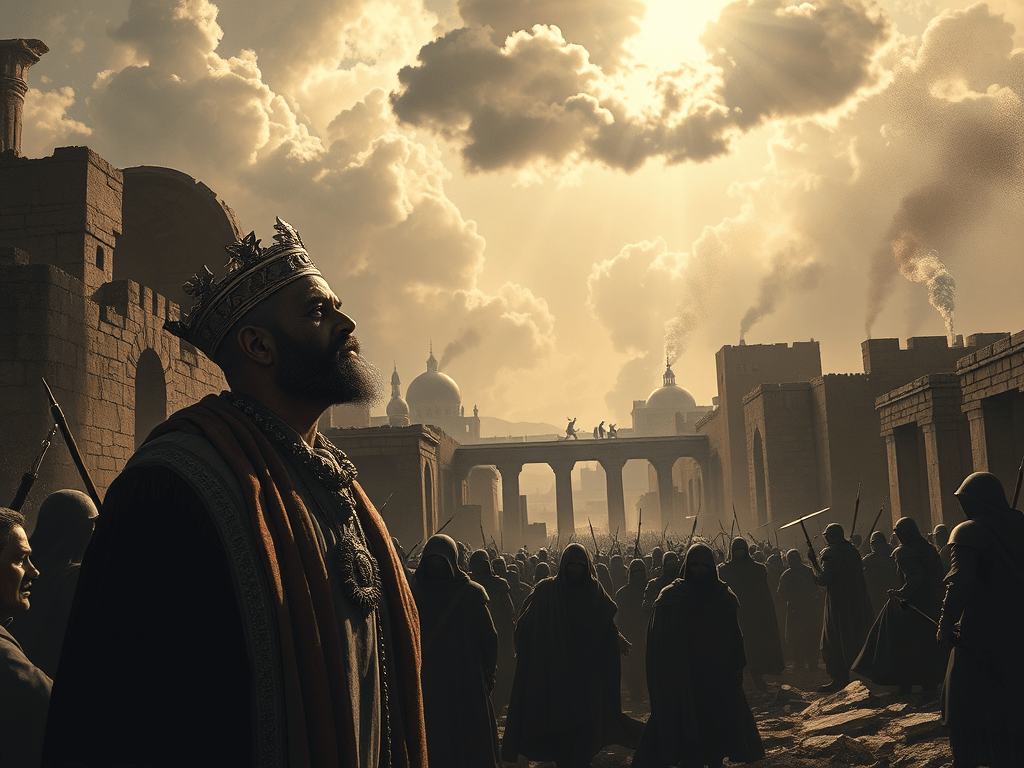
Jeremiah 21 marks a dramatic turning point in the book. Up until now, Judah has resisted Jeremiah’s message, assuming that God’s covenant guarantees their safety. But in this chapter, we discover something shocking: God Himself is now resisting His own people. Their rebellion has reached a point where deliverance will not come the way they expect.
This chapter forces every believer to ask:
What happens when we want God’s blessings but not God’s will? What happens when we want rescue without repentance?
Let’s walk through the passage verse by verse.
1. A King Who Wants a Miracle Without Obedience
Jeremiah 21:1–2 (WEB)
The word which came to Jeremiah from Yahweh, when king Zedekiah sent Pashhur… saying, “Please inquire of Yahweh for us, for Nebuchadnezzar king of Babylon makes war against us. Perhaps Yahweh will do one of His wondrous works for us, that he may withdraw from us.”
Zedekiah, the final king of Judah, is out of time. Babylon surrounds the city. Instead of repenting, instead of asking, “What have we done?” he sends messengers to Jeremiah with one request:
“Maybe God will pull off a miracle like He used to.”
This is what Walter Brueggemann calls “the illusion of guaranteed grace.” The people clung to the belief that God must save them because He had done so before.
But faith isn’t magic, and God is not obligated to bless rebellion simply because He has been merciful in the past. Scripture makes it clear when it states: “Shall we continue in sin so that grace may abound?” God forbid. We don’t act out of disobedience, assuming God will simply ignore it.
Practical Application
Many today want God to “fix” their situation without addressing the deeper issues of the heart.
We want deliverance without repentance, comfort without conviction, and blessings without obedience. The truth is, Jesus tells us to pick up our cross and follow him. He tells us that if we can’t even weather through the trials and persecutions we may receive from our closest family members, then we can’t be a disciple for Jesus.
Zedekiah’s request is familiar:
“God, please help me… but don’t change me.” However, as we all know, repentance is a change of mind that leads to a change of action. It comes from a word akin to a caterpillar turning into a butterfly. It’s a complete transformation, so much so that you can’t even recognize the original. That’s why God tells us to put off the old self and put on the new self.
2. God Turns Their Weapons Against Them
Jeremiah 21:3–4 (WEB)
“Thus you shall tell Zedekiah… ‘Behold, I will turn back the weapons of war that are in your hands… and I will gather them into the middle of this city.’”
Jeremiah’s answer is devastating:
“The miracle you’re asking for? The opposite will happen.”
The phrase “I will turn back your weapons” means Judah’s defenses will collapse internally. What they trusted in—walls, armies, alliances—will fail. Ultimately, we must put our trust in God. We can’t survive without his protection. God has to be our wall of fire and the glory in the midst.
John Gill notes that this imagery means God Himself “disarms the disobedient.”
Practical Application
God sometimes lets our self-made defenses collapse:
- That relationship we idolized falls apart.
- That financial security we trusted more than God evaporates.
- That sin we thought we had “under control” takes control of us.
Not because God is cruel, but because He wants to show us that nothing can save us except Him. I believe once we realize our complete dependence on Him, only then can God help us. It’s a miracle for humans not to stand in the way because of their pride or overconfidence. We must submit to God and repent.
3. God Fights Against His Own City
Jeremiah 21:5–7 (WEB)
“I myself will fight against you with an outstretched hand… in anger and wrath… I will strike the inhabitants… and deliver Zedekiah… into the hand of Nebuchadnezzar…”
This is one of the most terrifying statements in Scripture:
“I will fight against you.”
Normally, God’s “outstretched arm” is a phrase of salvation (Exodus 6:6). Here the same phrase describes judgment.
As David Guzik observes, the covenant blessings are reversed:
- Instead of God fighting for them, He fights against them.
- Instead of protection, there is plague.
- Instead of mercy, there is handing over to the enemy.
Why would God do this?
Because for decades they rejected His voice.
They loved the temple but not obedience.
They loved worship but despised holiness.
They kept the religion but rejected the relationship.
Practical Application
God will not bless what we refuse to surrender.
If we continually resist Him, eventually we discover that the battle we’re fighting is not with circumstances but with God Himself. This is a wake up call for all of us. If God didn’t spare the natural branches, then don’t think He will spare the Gentiles who were grafted in as adopted sons and daughters. What a sober reminder.
4. A Stunning Choice: The Way of Life or the Way of Death
Jeremiah 21:8–10 (WEB)
“Behold, I set before you the way of life and the way of death… He who stays in this city will die… but he who goes out and surrenders to the Chaldeans will live… For I have set My face against this city…”
This is shocking:
Obedience now looks like surrender.
Survival means walking out of the city and yielding to Babylon.
Why?
Because resisting Babylon now meant resisting God’s discipline. As D. J. Wiseman points out, Babylon was “the rod of Yahweh” (Jer. 25:9). To fight Babylon was to fight judgment itself.
**This is the gospel pattern:
life through surrender.**
- We die to self to live to Christ.
- We surrender our will to find His.
- We give up control to gain freedom.
Practical Application
Sometimes God tells us:
- “Stop fighting this.”
- “Lay it down.”
- “Let Me use this hardship for your good.”
- “Surrender before I can restore.”
The hardest obedience is often the one that requires humility.
5. Judgment on the Royal House
Jeremiah 21:11–14 (WEB)
“Hear Yahweh’s word, house of David… Execute justice in the morning… lest my wrath burn… I am against you, O inhabitant of the valley… I will punish you according to the fruit of your doings.”
The chapter ends with a direct word to the king’s household. Their responsibility was to maintain justice — especially for the poor and oppressed.
But they refused. Corruption ran deep. Oppression became normalized.
So God says:
“You will be judged by your deeds.”
Brueggemann writes that this section makes clear that “no amount of religious symbolism can cover over injustice.”
Practical Application
It is possible to:
- Attend church
- Speak Christian language
- Boast in religious identity
…while still living unjustly.
God is not impressed by the appearance of holiness — He searches the heart.
Conclusion: Jeremiah 21 Preaches Christ Through Judgment
The chapter is heavy. But it prepares us for the gospel.
Where Israel could not obey, Jesus obeyed.
Where the city fell because of sin, Jesus bore the judgment, outside the city walls.
Where God said, “Surrender to live,” Jesus invites:
“Whoever loses his life for My sake will find it.”
Jeremiah 21 teaches us that the safest place is not behind strong walls but under a soft heart.
 Conform to Jesus
Leave a comment