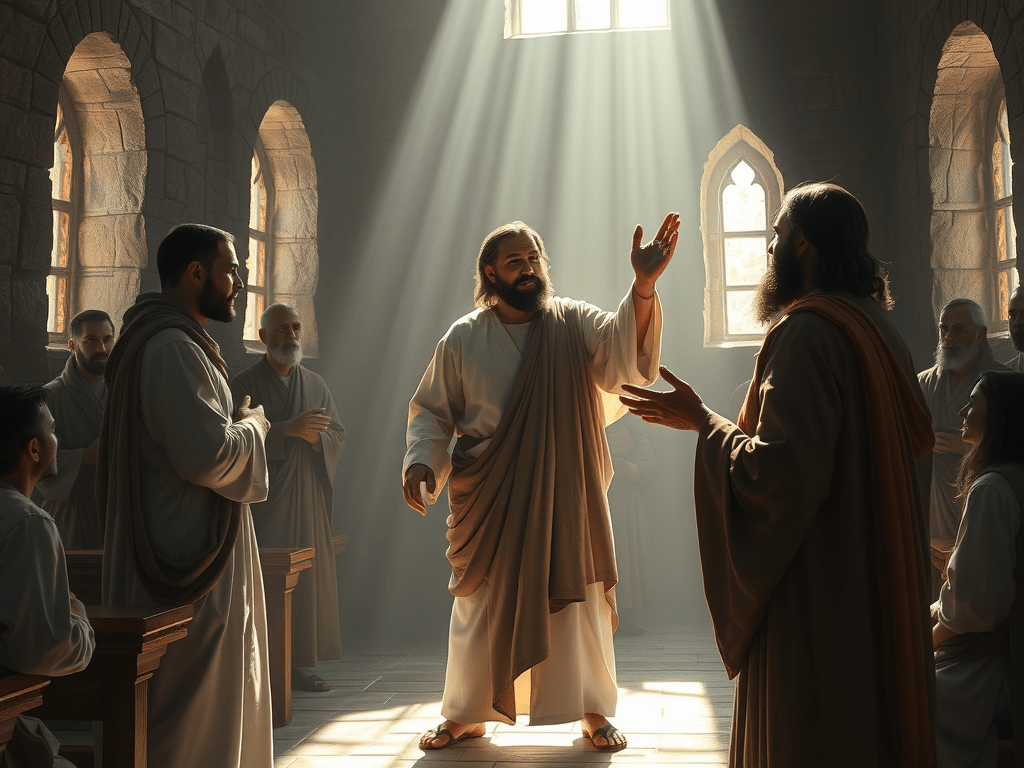
In a quiet synagogue, sunlight filters through narrow stone windows, drawing golden lines through the dust. The murmurs of the crowd hush as Jesus steps forward—calm, unwavering, filled with compassion. In the corner, Pharisees stand rigid, their eyes sharp with judgment. They’re not here to worship. They’re here to watch.
A man with a withered hand stands trembling in the center. Years of being ignored and pitied have worn him thin. His fingers curl in upon themselves, useless and lifeless. He doesn’t ask for attention, but Jesus sees him anyway. He always does.
The air feels heavy with silence as Jesus turns toward the Pharisees and asks,
“Is it lawful to do good on the Sabbath, or to do evil? To save life, or to destroy it?”
No one answers.
The question exposes the heart of the moment—law versus love, ritual versus mercy.
Then Jesus looks back to the man and says simply, “Stretch out your hand.”
The man obeys. His hand straightens. Tendons tighten. Color returns. For a moment, no one breathes. The miracle doesn’t roar—it whispers. The room fills not with applause, but awe. Even the dust seems to shimmer in the stillness.
The miracle is not loud.
It’s holy quiet.
Because true healing doesn’t need spectacle; it needs surrender.
Jesus didn’t heal to prove a point. He healed to reveal one.
The Sabbath wasn’t made to trap man in ritual but to free him to rest, to worship, to remember the goodness of God. Somewhere along the way, people began guarding the rules more than the relationship. They measured holiness by what couldn’t be done, not by the love that could be shown.
When Jesus healed that man, He didn’t abolish the law—He fulfilled it.
He showed that doing good is never in conflict with honoring God.
The Sabbath was always meant to refresh the soul, not restrict compassion.
That’s what makes this moment so powerful:
It’s not rebellion—it’s revelation.
It’s not defiance—it’s divine love expressed in motion.
I think back to my own moments of tension between caution and compassion. When I used to preach downtown Indianapolis, people would gather on street corners—some to listen, some to ignore, some just passing through. Every now and then, someone would come up, tired and hungry, and ask for help. I remember one man who approached me and said he hadn’t eaten in days. I gave him a hundred dollars.
Some told me later, “You shouldn’t do that. You never know what he’ll use it for.” Maybe they were right. But in that moment, I felt the same conviction Jesus must have felt in the synagogue: love matters more than safety, compassion more than control.
Because when you choose to love, you fulfill the law in the deepest way possible. You act not out of rebellion, but out of reflection—of the One who healed on the Sabbath not to make headlines, but to reveal the Father’s heart.
That man’s hand was restored, but something more was healed that day.
The crowd saw what the Pharisees couldn’t: that holiness isn’t fragile, it’s fierce.
It’s strong enough to move toward pain when others stand still.
The Sabbath was never about standing still—it was about standing in God’s presence.
And in that presence, love acts.
He still restores what was withered—hands, hearts, faith, compassion.
He still invites us to stretch out what’s paralyzed by fear, pride, or hesitation.
He still calls us to do good, even when the world says, “Wait until tomorrow.”
Because love doesn’t wait.
Love fulfills.
Love heals.
And even on the Sabbath, love never rests.
 Conform to Jesus
Leave a comment