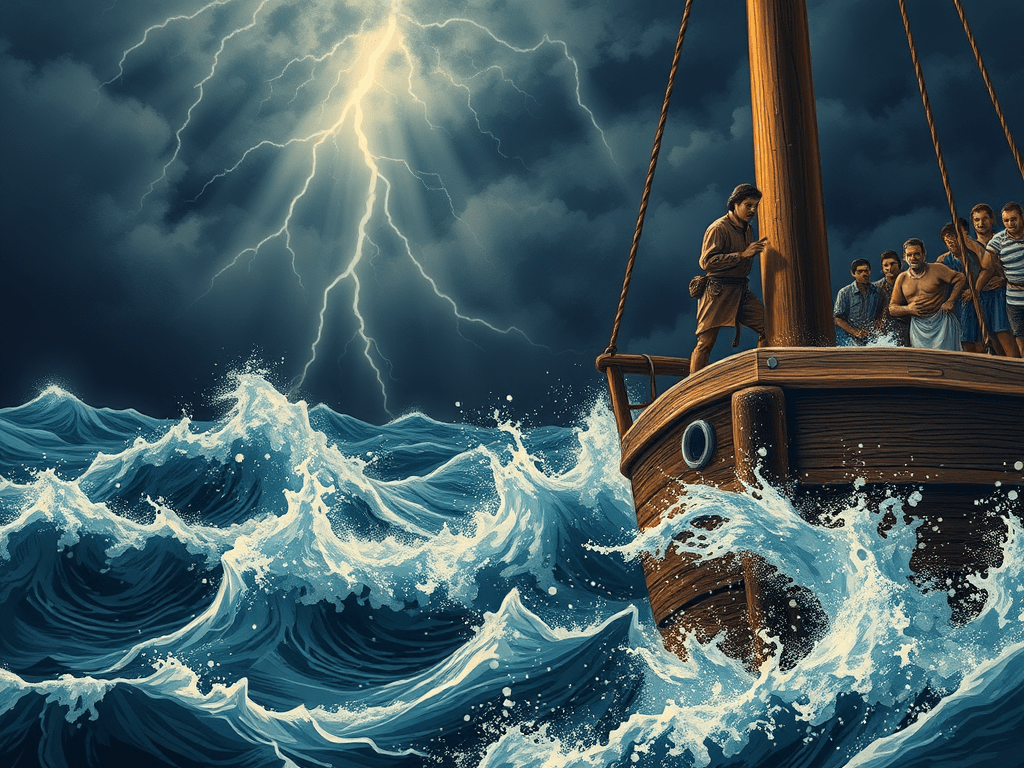
Then they said to him, “What shall we do to you, that the sea may quiet down for us?” For the sea grew more and more tempestuous (Jon. 1:11)
In Jonah 1:11, the verse presents the sailors asking Jonah, “What shall we do to you, that the sea may quiet down for us?” The Hebrew verb for “quiet down” (shaqat, שָׁקַט) conveys the idea of pacifying or calming, reflecting their desperate attempt to subdue the storm. The syntax underscores the urgency of the sailors’ plea, as the phrase “the sea grew more and more tempestuous” uses a repetitive structure in Hebrew to emphasize the escalating chaos.
This idea of escalating chaos is an indictment on Jonah and a testimony to the Lord’s overarching power. There is nothing that can stop the Lord from continuing the ravaging storm until Jonah comes to grips with his sin. Additionally, the mariners are aware of Jonah’s disobedience and begin to recognize God’s sovereignty concerning this situation.
This story reminds me of Paul in the New Testament when he is shipwrecked (Acts 27:13-44). It is here where his shipmates endure the storm and try to save themselves by lowering lifeboats. This is similar to the mariners, who threw all their cargo off the ship to make it lighter so that the boat didn’t sink. However, as time progressed, they realized it was more important to call on this God to save them rather than rely on their own human strength.
He said to them, “Pick me up and hurl me into the sea; then the sea will quiet down for you, for I know it is because of me that this great tempest has come upon you” (Jon. 1:12)
The phrase “Pick me up and hurl me into the sea” employs the Hebrew verb halaq (הָלַק), meaning “to throw” or “to cast,” a verb used in the Old Testament to indicate an action of force, often associated with judgment or expulsion. Jonah’s willingness to be thrown into the sea reflects both a sense of responsibility and a willingness to endure judgment for his actions, acknowledging that his disobedience has brought calamity upon others.
This idea of Jonah sacrificing his life to calm the storm parallels many stories in the Bible, such as Abraham and his son Isaac. Eventually, it was a ram that was sacrificed instead, which foreshadowed the coming of Jesus, who is the lamb of God that takes away the sins of the world. As you understand, Jesus bore the guilt of all humankind, so that when he died on the cross, God’s wrath was fully released upon His Son. Just like Jonah was tossed into the sea and it immediately calmed, so too when Jesus died the wrath was fully satisfied and completed (Rom. 5:6-8).
An interesting feature here too is that Jonah doesn’t blame anyone. He doesn’t say its the sailors fault or that God is being unjust. He doesn’t act like Eve who blamed the serpent, or Adam who blamed his own wife for eating of the tree of the knowledge of good and evil. Instead, Jonah knows he is being defiant, which reflects a deep awareness of his understanding of God’s justice and sovereignty.
Another thought-provoking angle is the idea of Jonah’s willingness to die. He doesn’t just seek escape; he seems to offer himself as a willing martyr, even though his death is not a necessary atonement. It’s not clear whether or not Jonah has good intentions here because he is still fleeing from God. Furthermore, you see that he is upset that the Ninevites had repented. So it’s a mystery as to how Jonah should be perceived, as an act of self-sacrifice in love or a selfish way to give up on the Lord’s calling for his life. What do you think?
Nevertheless, the men rowed hard to get back to dry land, but they could not, for the sea grew more and more tempestuous against them (Jon. 1:13)
In Jonah 1:13, the sailors face an increasingly dire situation, one that seems to mock their best efforts. Despite their knowledge and skill, they find themselves helpless against the power of the storm, which continues to grow in intensity. The Hebrew phrase וַיָּרֻ֣ד (“vayyārud”), meaning “they rowed,” conveys their desperate attempt to row the ship toward land, their every effort a fight against the raging waves. This word choice, in the imperfect form, emphasizes that their struggle is ongoing and intense, yet ultimately futile.
The mariners did have good intentions as they were attempting to save everyone on board, including Jonah, and really thought they could use their own strength as a mechanism for getting out of this situation. But you can see from the biblical text that there was no way for them to outmaneuver or overpower God’s will. This is further underscored by the verb וַיִּֽתְחַ֣ם (“vayitcham”), meaning “they tried with all their strength” or “they strained,” which suggests an all-out physical effort, yet one that will ultimately prove powerless against God’s sovereign will.
As the storm intensifies, the sea “grows more tempestuous,” as described by the verb רָֽעָֽב (“raav”), meaning “to hunger” or “to grow more violent.” The storm is depicted almost as an insatiable force, consuming all in its path. This metaphorical “hunger” of the sea mirrors the unstoppable nature of divine wrath, as if the storm were actively seeking to devour the sailors and the ship, showing that human efforts are powerless in the face of God’s will.
Finally, the phrase בִּהְיֹֽות֙ לַשִּׁיּֽוּר (“b’hyot l’shiyur”), meaning “when it became more tempestuous against them,” signals the climactic moment when the storm’s power cannot be denied. It is not just a natural occurrence; it is a divine force that escalates precisely as the sailors attempt to defy it.
This story reminds me of the futile attempt Pharoah’s army to attack Moses and the Israelites as they crossed the Red Sea. All Moses did was stretch out his hand, and the Lord caused the sea to go back by a strong wind (Ex. 14:21-30). This completely wiped out the entire Egyptian army, and there was absolutely no way to overcome God’s sovereign power.
I am also reminded of the time when Job has a conversation with God. In Job 38:8-11, God begins to ask Jonah several questions, one of which he states: “Or who shut up the sea with doors, when it brake forth, as if it had issued out of the womb? When I made the cloud the garment thereof, and thick darkness a swaddling band for it, And brake up for it my decreed place, and set bars and doors, And said, Hitherto shalt thou come, but no further: and here shall thy proud waves be stayed?” This just proves that Yahweh has absolute power over nature and human will.
Subscribe to get access
Read more of this content when you subscribe today.
 Conform to Jesus
Leave a comment