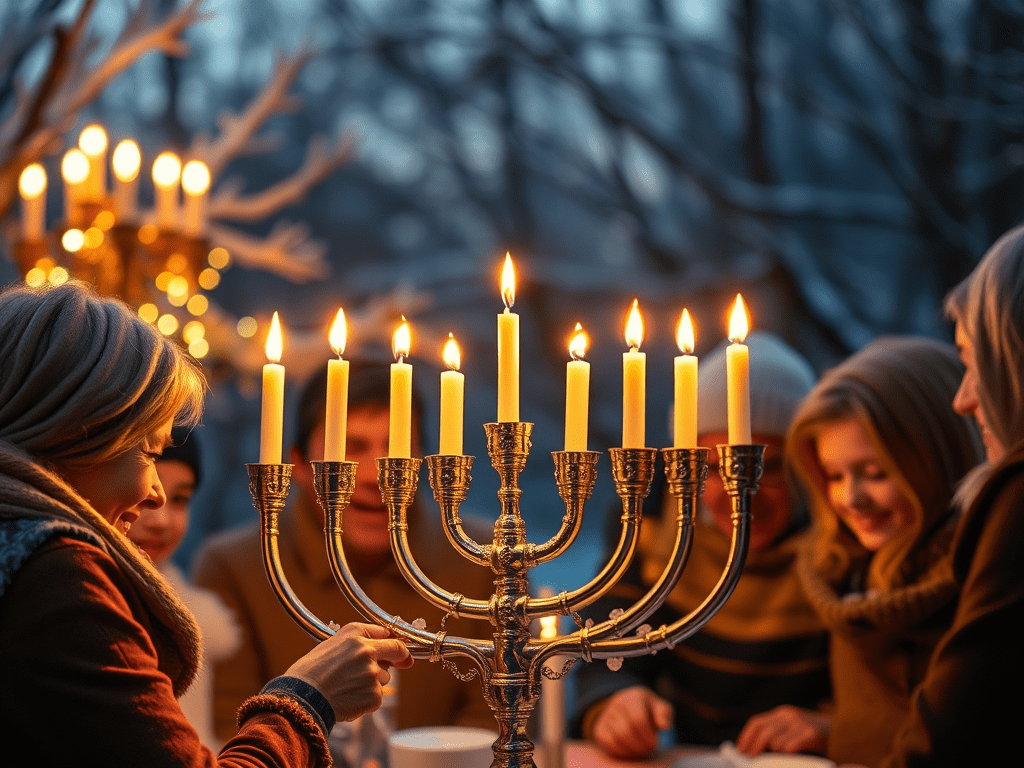
Hanukkah, also known as the “Festival of Lights,” is an eight-day Jewish celebration that commemorates a pivotal moment in history—the rededication of the Second Temple in Jerusalem after a victorious revolt.
Celebrated in the winter, Hanukkah typically coincides with the month of December, and this year, it runs from December 25 to January 2. The same time as Christmas. But beyond its historical roots, Hanukkah is a time for family, faith, and reflection on the light that shines even in the darkest of times.
As a Messianic Jew, my family and I celebrate Hanukkah with deep reverence and joy, recognizing its rich spiritual significance that points us to the faithfulness of God and the light that came into the world through Jesus Christ.
Moreover, we celebrate Hanukkah because it is a reminder of God’s faithfulness, both in the past and in our present lives. In John 10:22, we see that Jesus Himself celebrated this feast:
“Now it was the Feast of Dedication in Jerusalem, and it was winter.” (John 10:22, NKJV)
By observing Hanukkah, we are following in the footsteps of our Messiah, who honored this festival. For us, this celebration isn’t just about remembering an ancient miracle—it is also an opportunity to honor the Lord Jesus, the true Light of the world, who came to rededicate our hearts and bring us salvation.
During this time, we gather as a family to light the menorah, sing prayers, and reflect on how Jesus is the fulfillment of the light that the Maccabees brought to Israel. Just as the menorah shines brightly during Hanukkah, we believe that Jesus, the Light of the World, shines even brighter in our hearts, bringing hope and redemption to all who believe.
Hanukkah also serves as a time for us to express gratitude to God for His provision and to strengthen our faith in His ongoing work in our lives. We cherish the traditions of the holiday, but above all, we focus on the deeper truth—that the light of Hanukkah points to the eternal light found in Jesus Christ.
As a Messianic Jew, celebrating Hanukkah is not only an act of cultural remembrance but also a spiritual declaration of our faith in Jesus as the Messiah. This is why, with joy and thanksgiving, we celebrate Hanukkah with our family, honor the Lord, and proclaim the light of His love to the world. But it’s more than just a holiday, there is a rich history behind this historical event.
The History of Hanukkah
In the second century BCE, the land of Israel was under the rule of the Seleucid king Antiochus IV Epiphanes. During his reign, he sought to impose Greek culture and religion on the Jewish people, outlawing Jewish practices and desecrating the Second Temple by sacrificing a pig on the altar. A small group of Jewish rebels, led by Mattathias and his son Judas Maccabeus, bravely stood up to Antiochus’ forces. Against all odds, they succeeded in driving the Seleucids out of Israel.
The first act following their victory was to cleanse and rededicate the desecrated Temple. When it came time to light the Menorah, a seven-branched candelabrum, they found only one small jar of consecrated oil, enough for just one day. Miraculously, that tiny amount of oil lasted for eight days, allowing the Temple to be fully restored and the Jewish people to celebrate their victory.
There are so many verses in Scripture that should encourage both Christians and Jews to celebrate this landmark victory over the evil Antiochus Epiphanes. For instance, Isaiah 9:2 tells us: “The people who walked in darkness have seen a great light; those who lived in a land of deep darkness—on them has light shined.” How true is this because God our Father protected the Maccabean from being destroyed by the pagan people so that God’s word would still be strong today.
Finally, I think of Hanukkah from Matthew 5:14-16 as a beautiful reason for us to celebrate this marvelous holiday:
“You are the light of the world. A town built on a hill cannot be hidden. Neither do people light a lamp and put it under a bowl. Instead, they put it on its stand, and it gives light to everyone in the house. In the same way, let your light shine before others, that they may see your good deeds and glorify your Father in heaven.”
How Hanukkah Is Observed
At the heart of Hanukkah is the lighting of the menorah, a special candelabra with nine branches. One branch, known as the shamash, is used to light the other eight candles, one for each night of the festival. On the first night, one candle is lit; on the second, two candles are lit, and so on, until all eight candles are glowing on the eighth night.
Every night, blessings are recited before the lighting, and traditional songs are sung afterward. The menorah is often placed in a window or doorway to publicize the miracle and spread its light. In some communities, giant menorahs are displayed in public spaces like city halls and parks, bringing the festival’s message to a wider audience.
In many ways, this mirrors the celebration of Christmas, but with an even greater significance. Christmas marks the birth of Jesus, the Light of the World (John 8:12), who came into a dark world to bring salvation, just as the menorah’s lights illuminate the darkness each night of Hanukkah. Jesus Himself celebrated Hanukkah (John 10:22-23), during the Feast of Dedication, showing us that the principle of light overcoming darkness was something He embraced and exemplified.
When we light the candles of the menorah, we are reminded not only of the miracle that took place in the days of the Maccabees but also of the ultimate miracle of Christmas, where God’s light entered the world in the form of Jesus Christ, bringing salvation and hope to all people. The menorah’s light represents the victory of faith and the persistence of God’s promises, just as Christmas celebrates God’s fulfillment of His promise through the birth of Jesus.
The lighting of the menorah can also be seen as a precursor to the profound truth we celebrate at Christmas: Jesus came to bring light to a world lost in darkness. Just as the menorah illuminates the home, so too does Jesus, the true Light, illuminate the hearts of believers. Each night of Hanukkah, as the flames grow brighter, we are reminded that the light of Christ continues to shine in our hearts and in the world.
As we light the menorah and celebrate Hanukkah, we honor the light that overcame the evil of Antiochus and the darkness of sin through Jesus Christ’s birth, reminding us of His role as the fulfillment of God’s promise of deliverance. This is the ultimate reason for celebration: both the victory of the Jewish people in the days of the Maccabees and the coming of Jesus, who conquered the ultimate darkness through His birth, life, death, and resurrection.
The menorah’s placement in windows or public spaces also parallels how Christians today share the message of Christ’s light with the world, bringing the hope of Christmas into the public sphere, illuminating the hearts of those around us. Just as the menorah is displayed to publicize the miracle of Hanukkah, Christmas is a celebration meant to be shared and spread to all, shining a light of hope and joy in every corner of the world.
Subscribe to get access
Read more of this content when you subscribe today.
 Conform to Jesus
Leave a comment