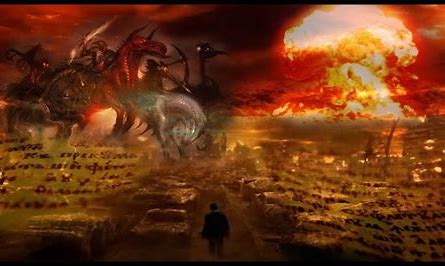
Revelation 10:1 (WEB): “I saw a mighty angel coming down out of the sky, clothed with a cloud. A rainbow was on his head. His face was like the sun, and his feet like pillars of fire.”
The word “mighty” in Greek is “dunatos,” emphasizing not just strength but inherent ability. This highlights the angel’s divine power as he descends, clothed in a cloud with a rainbow, symbolizing God’s covenant and majesty, further underscoring the celestial and authoritative nature of the angel.
This imagery also reminds readers of God’s prior judgment during Noah’s flood. He promised never to destroy creation with the waters again by making a covenant with them. The rainbow was this sign, a promise of God’s mercy and grace.
While there will be an ultimate judgment coming, God is not willing that anyone perish, but all come to repentance and faith. As in the days of Noah, so shall it be, however, when the Son of man returns. People were mocking God then, and they are mocking God now. It is my hope and prayer that people repent and trust in Jesus today!
Revelation 10:2 (WEB): “He had in his hand a little open book. He set his right foot on the sea, and his left on the land.”
The Greek word “biblion” for “book” signifies not just any book but a scroll, a common form of recording important texts in the ancient world. This choice of word adds depth to the symbolism of the open scroll, representing the revelation of divine mysteries. The angel’s dominion over the sea and land is reinforced through the Greek “set” (“estēken”), suggesting a stance of authority and control.
This verse reminds me of the time when Jonah was asked by the mariners who his God was. And he responded, saying, “I worship the LORD, the God of the heavens, who made the sea and the dry land.” During the time Jonah lived, most people worshipped territorial gods, so it was a surprise to hear that His God was all-powerful over every dominion.
Revelation 10:3 (WEB): “He cried with a loud voice, as a lion roars. When he cried, the seven thunders uttered their voices.”
The Greek term “bronte” for “thunders” underscores the awe-inspiring nature of these divine utterances. The use of “thunders” implies not just a sound but a powerful proclamation, akin to the roaring of a lion. This emphasizes the majestic and authoritative character of the angel’s message.
God often uses this type of imagery to expression His divine power and dominion over creation. It is a stark reminder of our limited, contingent, and earthly mortality. May we look to the Creator of the heavens and the earth, who is all-powerful and immortal.
We serve an amazing God. A God who is very powerful, but also full of love and compassion. He shows us his goodness and attributes of love. For Scripture says the heavens declare the glory of God.
Revelation 10:4 (WEB): “When the seven thunders sounded, I was about to write; but I heard a voice from the sky saying, ‘Seal up the things which the seven thunders said, and don’t write them.'”
The Greek word “sphragizo” for “seal” adds depth to the act of sealing up the content of the thunders. This emphasizes the mystery and selective nature of God’s revelation, indicating that certain aspects of divine knowledge are beyond human understanding and are to remain undisclosed.
God has given us his Holy Spirit, who is the third person of the Trinity. The role of the holy spirit is to guide us into all truth, and to help us understand the divine plan of God. Whenever we are unsure of what Scripture is teaching, it’s vital to pray and ask God for wisdom.
While it’s also wise to seek guidance from your pastors and church leaders, it’s crucial to delve into the biblical text and come to the knowledge of the truth yourself. For God has given all of us the ability to understand what He has taught in His word.
Revelation 10:5-6 (WEB): “The angel whom I saw standing on the sea and on the land lifted up his right hand to the sky, and swore by him who lives forever and ever, who created heaven and the things that are in it, the earth and the things that are in it, and the sea and the things that are in it, that there will no longer be delay.”
The Greek “kairos” for “delay” is significant, hinting at a divinely appointed time, distinct from “chronos,” which denotes chronological time. The solemn oath, swearing by the eternal Creator, emphasizes the significance of the moment and underscores the urgency and imminence of the divine plan.
Doesn’t it seem like there has been this delay of God’s judgment? He is very patient with our broken and hostile world. As the world gets darker, I anticipate the light of Christ coming to this earth and restoring peace. I look forward to that day.
Revelation 10:7 (WEB): “But in the days of the voice of the seventh angel, when he is about to sound, then the mystery of God is finished, as he declared to his servants, the prophets.”
The Greek word “mysterion” for “mystery” carries deep theological meaning, representing divine truths that were once hidden but are now revealed. The completion of God’s mystery aligns with the fulfillment of prophetic declarations, underscoring the continuity and fulfillment of God’s redemptive plan.
The storyline of God’s word is the following: Creation, fall, redemption, and consummation. In it, we see God’s divine truth and redemptive plan at work. Creation shows God’s power and desire to have a personal relationship with creation. Fall reveals man’s sinful tendency and disobedience. Redemption is God, the hero of the story, finding a remedy for our sin by rescuing us from death through Jesus Christ.
For God so loved the world He gave His only Son. The Son, Jesus Christ, is our righteousness. For he who knew no sin became sin for us, so that we might receive the righteousness of God. This is the consummation or restoration that occurs when we trust in Jesus by faith. We are born again into the family of God. When we repent and trust in Jesus, we have passed from death to eternal life.
Revelation 10:8 (WEB): “The voice which I heard from heaven, again speaking with me, said, ‘Go, take the book which is open in the hand of the angel who stands on the sea and on the land.'”
The Greek “lambanō” for “take” emphasizes an active role in receiving and internalizing God’s Word. This highlights the responsibility and privilege of engaging with divine truth. The use of “open” reinforces the accessibility of the scroll, making it available for John to take.
God’s word is not meant to be esoteric or hidden in meaning. God speaks to us plainly. The scroll is meant to be open and unveiled. While there are indeed hard truths to ponder and contemplate upon, through the power of the Holy Spirit, all things can be understood.
Revelation 10:9 (WEB): “I went to the angel, telling him to give me the little book. He said to me, ‘Take it, and eat it up. It will make your stomach bitter, but in your mouth it will be as sweet as honey.'”
The Greek “pipto” for “eat” captures the profound act of ingesting God’s message, suggesting a surrender to the transformative power of divine truth. The contrast between the sweetness in the mouth and the bitterness in the stomach adds depth to the emotional and spiritual impact of the prophetic calling.
This analogy is perfect because God’s word is sweet in that it restores the soul. It gives us joy and happiness. God’s word is also full of grace and happy news for all of us. At the same time, God’s word can be bitter.
Revelation 10:10 (WEB): “I took the little book out of the angel’s hand, and ate it up. It was as sweet as honey in my mouth. When I had eaten it, my stomach was made bitter.”
The Greek “pipto” again emphasizes John’s obedience in consuming the scroll. The duality of the experience, sweet in the mouth but bitter in the stomach, reflects the paradoxical and transformative nature of God’s Word, impacting both the emotions and the spirit.
The reason is embracing the truths can be difficult. God says tough things, such as repent of your sins. He tells us that the narrow road that leads to life is very narrow, and only a few people ever find it. This grim reality we face makes God’s word bitter at times.
Revelation 10:11 (WEB): “They told me, ‘You must prophesy again over many peoples, nations, languages, and kings.'”
The Greek “prophēteuō” for “prophesy” emphasizes an ongoing and authoritative declaration of God’s truth. The universal scope of the commission, encompassing “peoples, nations, languages, and kings,” underscores the inclusivity of God’s message for all of humanity.
In Revelation 10, let’s continue to reflect on the truth of God’s word. May we all have the wisdom and courage to share our faith with the world who is in dire need of Him. Let’s pray for God’s Holy Spirit to move mightily in our lives, in this generation, and the generation to come. Amen.
 Conform to Jesus
Leave a comment