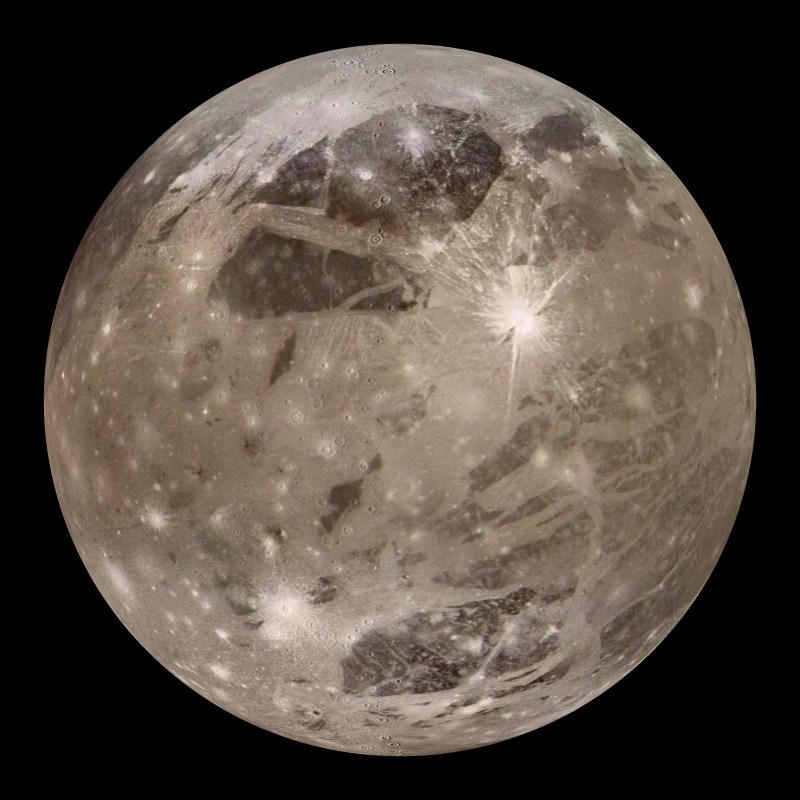
In the vast expanse of our solar system, Jupiter’s moon Ganymede stands out as an enigmatic celestial body. On June 7, 2021, NASA’s Juno spacecraft ventured closer to Ganymede than any previous spacecraft had ever dared. This moon, the largest in our solar system and even larger than Mercury, has intrigued scientists for years, primarily because of its frozen surface, which could potentially harbor water. But what Juno’s latest mission revealed has left scientists scratching their heads and rethinking the age of Ganymede.
A Closer Look at Ganymede’s Surface
Juno’s recent flyby yielded a stunning image of Ganymede, captured in the green part of the spectrum, rendered in grayscale. NASA plans to release images in full color, but even the initial grayscale image has raised eyebrows. It revealed what appear to be fissures on Ganymede’s surface. NASA described these features as “long structural features possibly linked to tectonic faults.” This implies geological activity on the moon, and for geological activity to occur, energy is required.
The Dilemma of Ganymede’s Youthful Features
The discovery of these youthful features on Ganymede mirrors similar findings on other celestial bodies, like Earth’s moon and Pluto. If Ganymede, believed to be over 4 billion years old, indeed displays recently formed features, it challenges the notion that these bodies should be geologically dead by now. This conundrum perplexes proponents of long-age theories.
Water Vapor and the Mystery of Sublimation
Another intriguing aspect of Ganymede’s mystery is its atmosphere. In 1998, the Hubble telescope detected water vapor in Ganymede’s atmosphere. A 2021 report in the journal Nature Astronomy explained that sunlight striking the moon’s equator causes surface ice to vaporize, releasing water vapor into the atmosphere. This begs the question: Can ice keep sublimating off Ganymede’s surface for billions of years? Ganymede isn’t the only celestial body in our solar system losing water into space, challenging the assumption of extreme age.
The Unexpected Magnetic Field
One of the most unexpected discoveries related to Ganymede is its magnetic field. In 1998, spectral observations revealed electrified gas bands, providing evidence of a weak magnetic field on Ganymede. This revelation defies conventional wisdom because small celestial bodies like moons are not expected to have magnetic fields that have persisted for billions of years.
The Dynamo Theory Dilemma
Conventional scientists have relied on the dynamo theory to explain how planetary and lunar magnetic fields are maintained over vast time scales. This theory hinges on the presence of molten cores, which should have cooled and solidified eons ago on bodies like Mercury and Ganymede. Yet, these bodies still boast magnetic fields, defying the expectations of long-age theories.
A Young-Earth Perspective
From a young-earth perspective, these mysteries find an explanation. Creationist Dr. Russell Humphreys proposed a model in which planetary magnetic fields were initially established by aligning the spin magnetic moments of protons in water molecules. According to this model, the cores of celestial bodies were created as water with aligned nuclear spins, later transmuting into iron and iron sulfide. This initial alignment generated a strong magnetic field, which has been decaying exponentially over time. Humphreys’ model has successfully explained the magnetic fields of Earth, our Moon, and other solar system planets.
Ganymede’s Magnetic Field in a Young-Age Framework
In this framework, Ganymede’s magnetic field could still be in a state of exponential decay from its creation. The small size of Ganymede’s core and the lack of significant heat sources in the present day make the conventional dynamo theory implausible. But, Humphreys’ model provides an alternative explanation that aligns with the biblical view of a young Earth.
A Potential Role for Subsurface Saltwater
Researchers also suspect that Ganymede may have a subsurface layer of liquid saltwater, which could act as an electrical conductor. While this water layer might not generate a dynamo, it could contribute to minor variations in Ganymede’s magnetic field.
Conclusion
Ganymede, Jupiter’s largest moon, continues to defy our expectations and challenge long-age theories about the age of celestial bodies. Its youthful features, unexpected magnetic field, and mysterious sublimation of ice all point to a celestial body much younger than previously believed. While conventional science grapples with these enigmas, the young-earth perspective offers a coherent and biblically aligned explanation for Ganymede’s mysteries.
References
1. See the First Images NASA’s Juno Took As It Sailed by Ganymede. NASA. Posted on nasa.gov June 8, 2021, accessed August 2, 2021.
2. Watters, T. R. et al. 2010. Evidence of Recent Thrust Faulting on the Moon Revealed by the Lunar Reconnaissance Orbiter Camera. Science. 329 (5994): 936-940.
3. At Pluto, New Horizons Finds Geology of All Ages, Possible Ice Volcanoes, Insight into Planetary Origins. New Horizons News Center. Posted on pluto.jhuapl.edu November 9, 2015, accessed August 2, 2021.
4. Roth, L. et al. A sublimated water atmosphere on Ganymede detected from Hubble Space Telescope observations. Nature Astronomy. Posted online before print, July 26, 2021.
5. Hubble finds first evidence of water vapor at Jupiter’s moon Ganymede. NASA. Posted on hubblesite.org July 26, 2021, accessed August 2, 2021.
6. Cassini Spacecraft Reveals 101 Geysers and More on Icy Saturn Moon. Jet Propulsion Laboratory. Posted on jpl.nasa.gov July 28, 2014, accessed August 3, 2014.
7. Bauer, M. Rosetta Arrives at Comet Destination. European Space Agency. Posted on esa.int August 6, 2014, accessed August 6, 2014.
8. Williams, M. Jupiter’s moon Ganymede. Physorg. Posted on phys.org/news October 15, 2015, accessed August 3, 2021.
9. Humphreys, D. R. 2013. Planetary Magnetic Dynamo Theories: A Century of Failure. Proceedings of the Seventh International Conference on Creationism. Pittsburgh, PA: Creation Science Fellowship.
10. Bland, M.T., Showman, A.P. and Tobie, G., The production of Ganymede’s magnetic field, Icarus 198:384–399, 2008. Return to text.
11. Spencer, W.R., Tidal Dissipation and the Age of Io, Proceedings of the Fifth International Conference on Creationism, Creation Science Fellowship of Pittsburgh, PA, pp 585–595, 2003
 Conform to Jesus
Leave a comment